Technical paper on carrying weakness by Karin Kattwinkel
How good is your horse’s back? Is it strong enough for the rider’s weight or tired and weak?
Article by horse health trainer Karin Kattwinkel (Dipl. Ing. agr.)
Have you ever asked yourself whether your horse can really carry you? And if so, how long without suffering damage? Are horses actually strong enough by nature to carry a rider?
Certainly not the latter. Because they are “constructed” by nature as grazing animals without a load on their backs. Because their food was originally quite low in energy (steppe grass) and they had to move many kilometres day in, day out to get their fill and find water, they carry more than half of their own weight without having to use muscle power thanks to the neck-back ligament system and some ingenious details in the skeleton. The longer and lower the neck is carried (grazing posture), the less effort is required. In this posture, more than half of the rider’s weight is carried without muscular effort. But also the wide forward stride of the hindquarters makes it easier to carry the rider’s own weight (and also that of the rider). That is why forward-downward riding and skilful driving towards the bit are guarantors for healthy riding horse backs. Unfortunately, you see them less and less.
Pulling” in the front and “stabbing” in the back is just as damaging as “riding without contact”.
Where ambitious sport riders and imitators pull the horse’s neck short and the nose behind the vertical, the horse’s back is definitely tense. But many recreational riders who deliberately do not want to make these mistakes are also harming their horses. Long riding on a loose rein and/or too little driving also makes the horse’s back tired.
Many horses get into a state of weakness at a young age because they have already been loaded with rider’s weight during unfavourable growth phases and had to “walk on the reins”. Then you buy this old burden with them, so to speak. Most horses do not get out of this condition on their own.
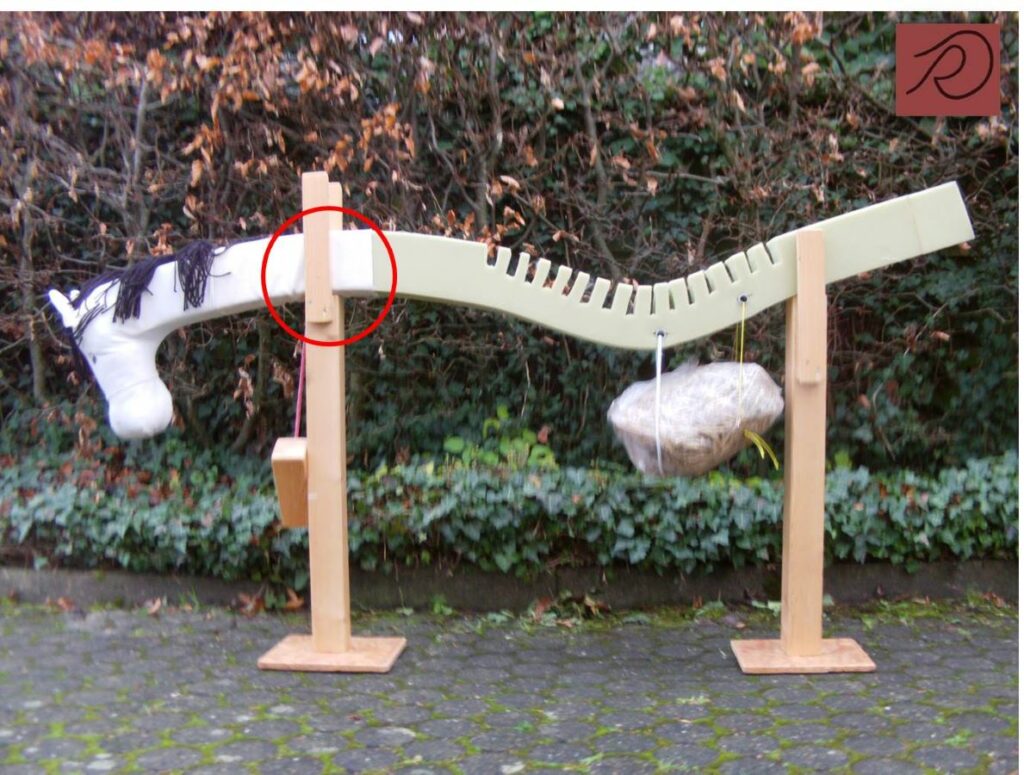
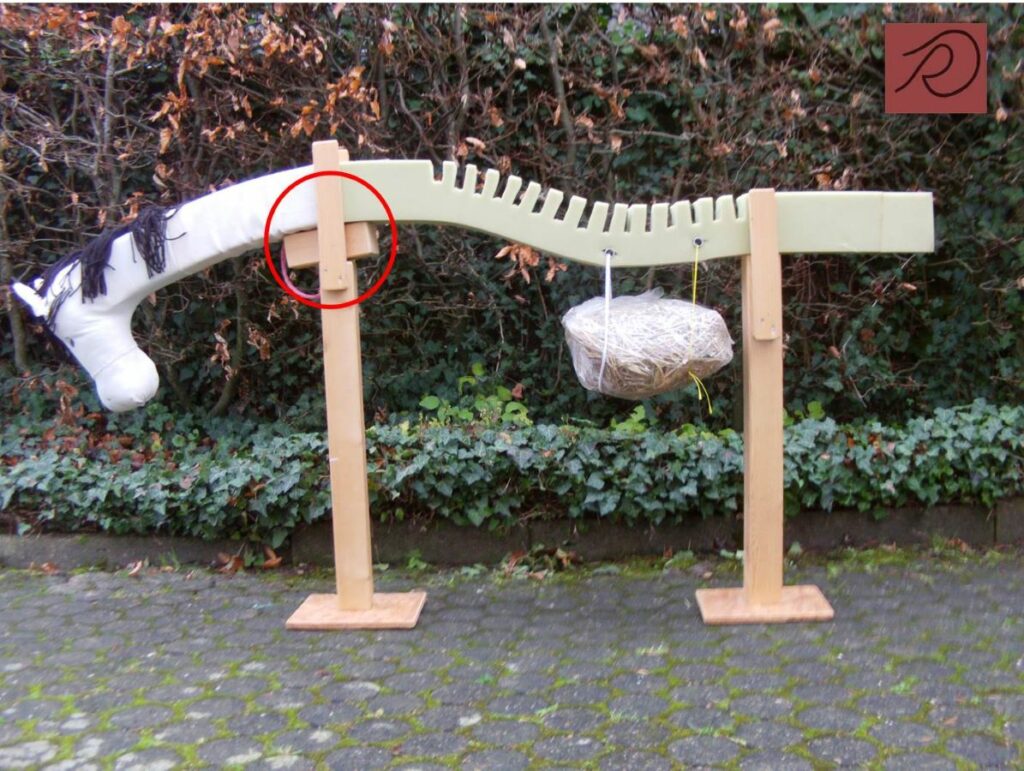
How to recognise carrying weakness
This is when the chest and back sag downwards. This overloads the chest muscles and overstretches the neck muscles. The shoulder blade muscles tense to achieve stability. The croup muscles pull to lift the back from behind. The hindquarter muscles (trouser muscles) pull to stabilise the pelvis. They are often overdeveloped. Often the carrying weakness is associated with blockages in the base of the neck and the neck joints. It is often caused by improper and too early breaking in.
Other or additional causes can be
- Too heavy a rider
- Too much weight of the horse itself (pasture belly, pregnancy)
- Riding for too long for the horse’s current state of training
- Too short and/or always the same rein measure
- Use of short and/or rigid auxiliary reins
- Clamping saddle
- Clamping rider
- Active rearing with the hand
- Disharmonious hoof balance
- Pain in the legs/hooves
- Lack of impulsion from behind (hindquarters do not go under)
What to do when the horse’s back is tired?
Any measures that reduce the pressure on the back, allow the back to stretch, stimulate the abdominal and thoracic muscles to work again and activate the hindquarters are helpful.
These include:
- Working freely or on the lunge line without a saddle and without a girth at a brisk pace (after the warm-up phase) with many transitions between gaits and at the pace of each gait.
- Initially work only on large lines
- Include cavaletti and small jumps
- Extensive walks in the countryside or as a hand horse
- Circus lessons: Bowing, complimenting, platform work (only front legs on platform, important: mount with low head)
- Work on the hand: Shoulder in at a walk alternating with voltes
- At the earliest in 3 months, cautious re-start (light, well seated rider, optimally fitting saddle, lots of cross-country – uphill and downhill, calm cantering)
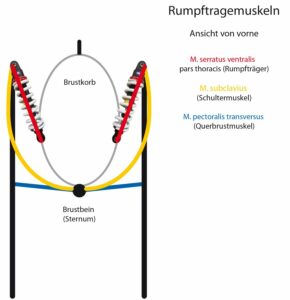
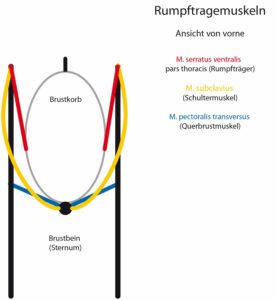
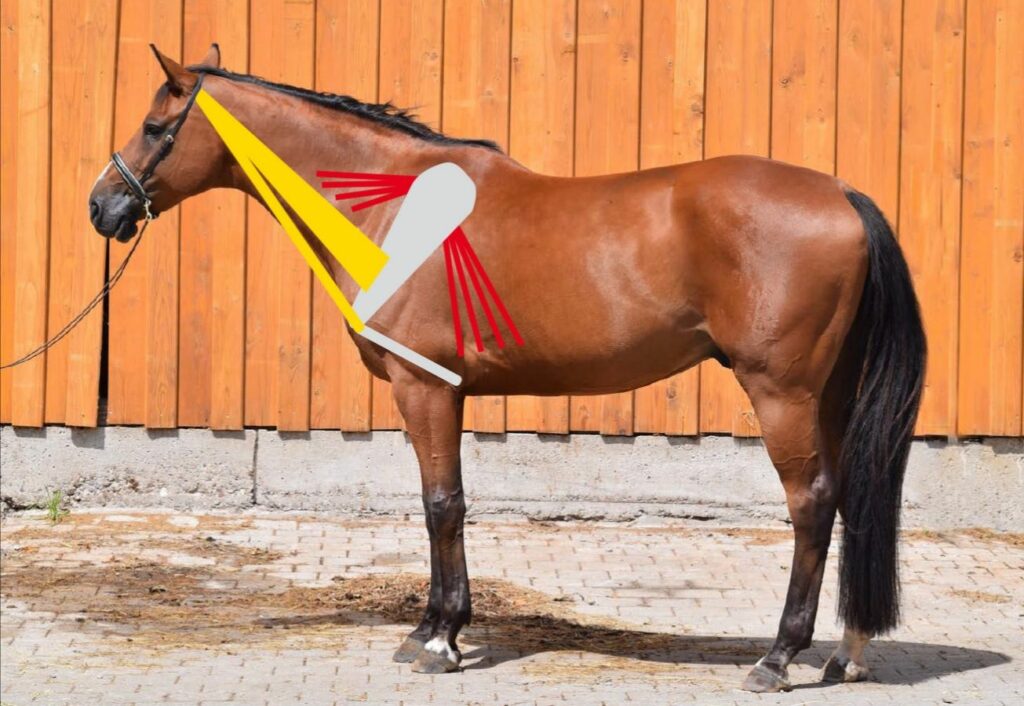
red: m. serratus (neck part and thorax part), yellow: long hyoid muscle and neck part of the m. longissimus, grey: scapula and upper arm (Photo: Peter Selbach)
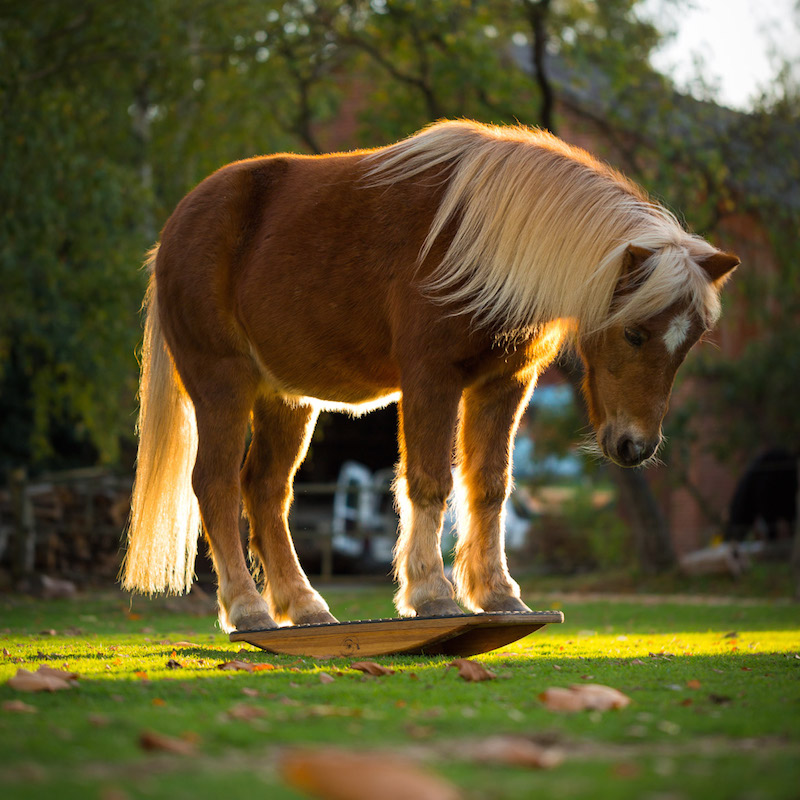
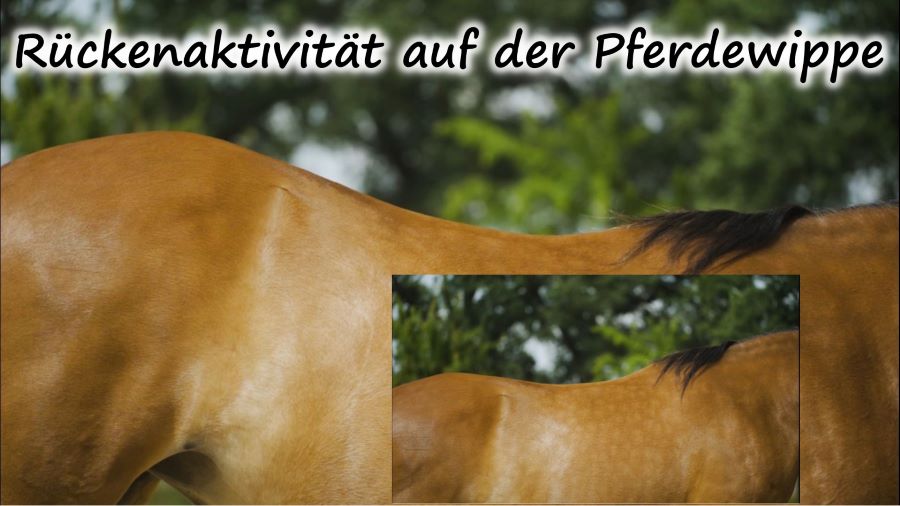
Rocking helps: By rocking back and forth on the seesaw, many tensions are released and the coordination of the muscles improves. It is a varied exercise for horses.
Longitudinal rocking strengthens the ventral muscle chain and relaxes the topline.
Lateral rocking strengthens the thoracic and thorax stabilising muscles.
The build-up phase should be accompanied by physiotherapeutic exercises such as lengthening the topline via tail traction, lifting the belly via provocation with the fingers along the abdominal seam, closing the hindquarters in stance as well as circus lessons such as bowing or standing with the front legs on a platform while eating from the ground.
More info on this and many other topics at www.equo-vadis.de. Recordings of the webinar series “Raus aus der Trageschwäche” as well as the hybrid calendars with step-by-step plan for therapy and training including instruction videos www.equovadis-shop.com.
FB group “Raus aus der Trageschwäche”.
I would like to thank Karin very much for this important and informative contribution to our blog! It is such a significant topic and really deserves our attention in training.
If you want to offer your horse exceptional deep muscle training, mobilisation and fun rehab (or prevention!), we have another very special offer for you here: The Steigerwald.Trainer for horse rocking will start soon. Here you will learn from the beginnings to the challenging lessons how to use the horse rocker in an optimal and versatile way for health maintenance, rehabilitation training and muscle building. I will accompany you and your horse individually and closely, which is why places are limited, so take your chance and invest in your horse’s health!