Horse Seesaws: Which size fits?

What are the questions that horse people who are concerned with sensible gymnastics through seesaw training ask? Of course, a lot is about how to get the horse to move on the seesaw in such a way that his musculoskeletal system gets the greatest possible benefit from it. But before the beautiful muscles can sprout, the right size of seesaw has to be chosen. In our seesaw shop

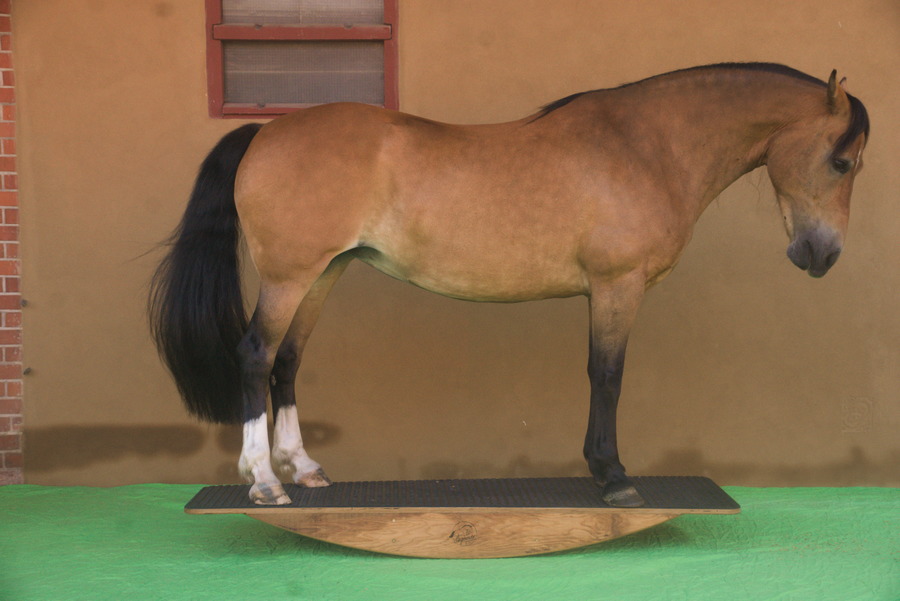
we offer the so-called full-body seesaws. We created the name because, on the one hand, the whole horse’s body is trained on it and, on the other hand, there is usually not much more space on such a seesaw than for a whole horse’s body.
In the seesaw shop there is a size finder that is based on the horse’s stature, but I would like to address a few other important factors.
An easily measurable parameter for the right horse rocker is the so-called “wheelbase.” There are square and rectangular types of horses, which come in different lengths for the same stick size.
To determine the wheelbase, I recommend the following procedure: You stop your horse from moving and measure the length from the tip of the front hoof to the ball of the equilateral hind hoof. Then let your horse walk a few steps, stop again and measure again. After five measurements, take the cut and find the length your horse needs for full body rocking.

Now, many equids often lie exactly on the border between two rocker sizes. We offer them in 1000, 1250, 1500 and 2000 millimetres length in the footprint. This is also the reason for the product designations, e.g. T-1500 of the Steigerwald.T horse saddles.
What if your horse has a wheelbase of 160 centimetres? Of course it can also bob nicely on a Steigerwald.T- 1500, if it puts itself together a bit there. But it can only bob in this way, because there is simply not enough room for all the other positions. The particularly beneficial effect of the loose swinging on muscles, fasciae, tendons, ligaments and joints cannot be achieved in this way. The reason for this is that your horse has to build up and maintain a certain tension in order to be able to stay on the reduced and unstable support surface at all. The stretching, relieving component of the “teeter-totter” movement is therefore considerably less.
Of course, the “rocking mountain goat” is a great workout and a real eye-catcher especially for people who find it hard to believe that you can get horses on such training equipment at all. Anyone who has ever sat on a horse’s back and felt the different types of seesaws will confirm that there is a lot of tension in the whole body when it pushes itself together on the little horse seesaw.
That’s why I recommend a larger size when choosing a horse rocker. You can place your horse sometimes more open, sometimes more closed, sometimes slightly sawhorse-like like a rocking horse, sometimes more at the front end, sometimes more at the back end of the seesaw. And then you have a much greater variance in the strain on the muscles.
Then, of course, there is the question of how old your horse is, or whether he has physical problems such as spavin or problems with his spine. In this case it makes sense to make the task easier for such a candidate.
Especially stepping on the seesaw is easier if there is more space. This also applies to horse-human teams that do not have much experience with ground work or clicker training. An experienced trainer can set the horse tricky tasks such as a shire on a two-legged see-saw with fewer mistakes and more success.

If the seesaw is to be used more on a trail and for riding over, the T-2000 is a good choice. Due to the longer overhang, it has a fixed end for stepping on and off. This allows horses that need to balance the rider in addition to their own body to move safely into instability. It is approved for up to 800 kilos in wood and up to 1000 kilos in stainless steel and can also be managed by less experienced teams with a little practice.
After all, gymnastics training should be gymnastics with fun! If the tasks are easy to understand and manage, especially at the beginning, the joy is greater on both sides. In the Steigerwald.T Online Academy you can find great webinars on seesaw training (LINK) and there are now some seesaw trainers who can help with questions.
But back to the size of the seesaw. Horses are known to be herd animals and it is possible that several horses share a rocker. The following applies here: Smaller equids can move any size of see-saw, my two Shetty geldings with their 100 and 105 centimetres of stature and 102 and 98 centimeters wheelbase respectively can move all horse seesaws well up to the T-3000. If you have a pony with a wheelbase of 115 centimetres, for example, it will be able to perform versatile seesaw training on a T-1500 or T-2000. A big advantage of a larger footprint horse rocker is that you can rock up and down together with your horse. There are three variations:
1. you let yourself move and let your horse do all the work.
2. you move your horse. This is wonderful for loosening up his muscles and strengthens your hindquarters 😉
3. you find a common groove of alternating activity and passivity. A wonderful way to move together with your horse!
There is no right and wrong, every seesaw moves differently, every hoof length change in position changes the whole balance structure. For transport, I always recommend using a handcart. This is a good way to move all the seesaws from A to B on your own and is easy on the back.
Whichever seesaw you choose and whichever one you are already using, enjoy the valuable training time you spend together with your horse!
Steigerwald.T Seesaw-Trainer

Frieda on the the horse seesaw

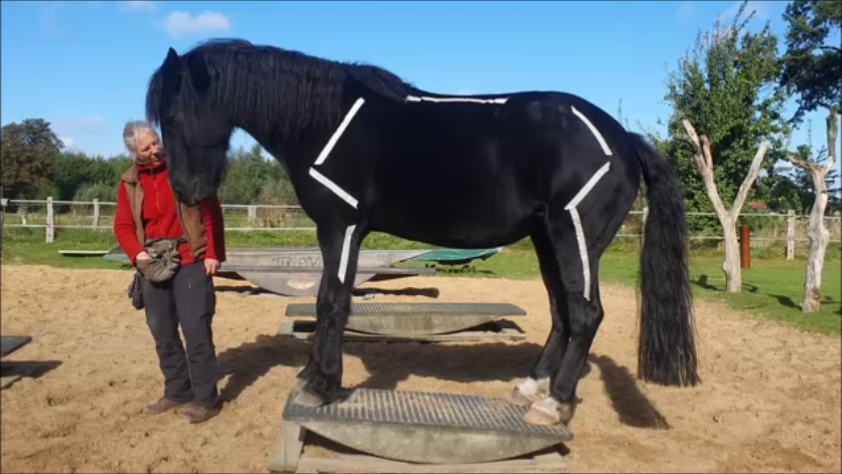
The enthusiasm for horse seesaws is growing at an impressive pace. The many positive effects on a wide variety of horses and ponies mean that more and more equids are enjoying the benefits of a rocker. The Steigerwald.T seesaw models can be used in many different ways: Even simply stepping on or over them promotes the work of the deep muscles and is a real challenge for the coordination skills. However, if you want to achieve the best for your horse, it is worth working towards independent, flowing “seesaws”. This activity strengthens the muscles and, most importantly, gently softens the fascia. To do this, your horse shifts its weight rhythmically back and forth. And please do all this without bending the joints or using the neck.
Teeter training is complex, training teeter-totters requires good timing and a certain amount of practice. And this is where the Steigerwald.T seesaw trainers come into play: they guide you and your horse to muscle training with fun and understanding. To receive the certificate, practical participation on a weekend at Hof Steigerwald is a prerequisite. On both days, all participants train with horses of different levels of knowledge. From stepping on a confined surface to first instability, creating rocking movements, independent rocking wapps to Hanken flexion, everything is included. So you not only get a comprehensive picture of the structure and procedures in teeter-totter training, you also learn practically which pitfalls to avoid and what to change if things don’t go as planned. And that is quite often the case with horses in real life ? .
Then it’s a matter of training two “journeyman horses” and documenting the training by video and writing. Regine Witten from Plus-R Pferdtraining met the challenge with flying colours with two Icelandic mares. You can find the training sequences for 10 bobbing wapps for a click as well as from the first step to the hank bend on Youtube.
This year, Simone Mender from Simones Pferdetraining and Nadine Senekowitsch from Positv Fairstärkt have fulfilled the requirements and help interested and committed people train with the horse seesaws. We are very happy that even more horses will be able to enjoy seesaw training and congratulate them!

Marengo’s Training Camp – Homeward bound

going for a walk

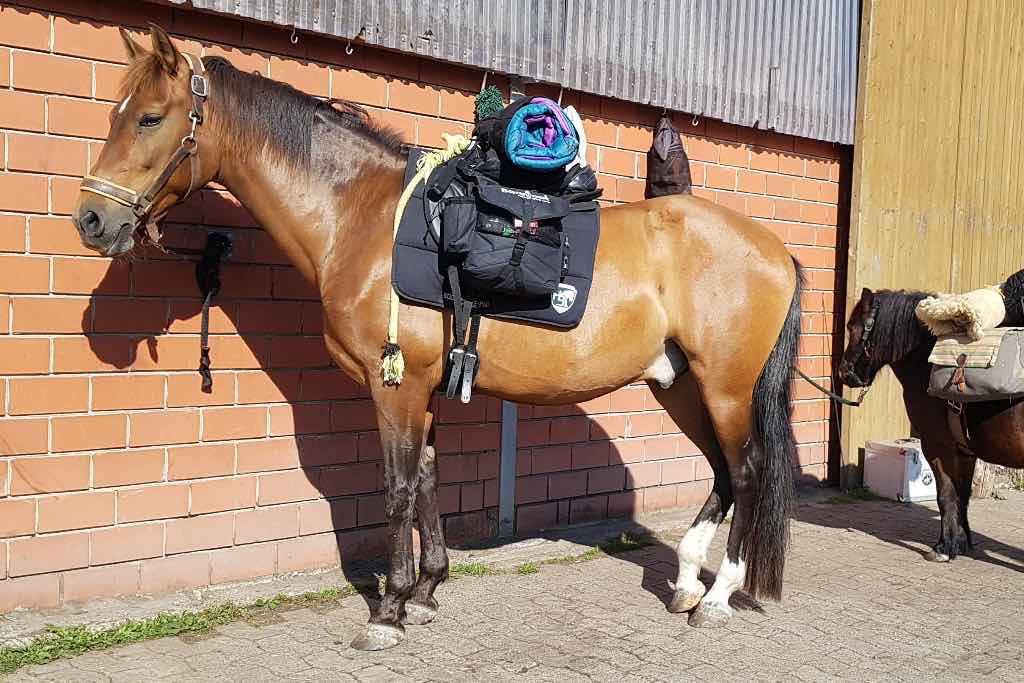
The highlight of Marengo’s seven weeks at Hof Steigerwald was to be a hike home. Sounded like a good plan, but if both participating humans are blessed with a heavy workload, it was also very ambitious. Marengo’s owner Nadine and I had 4 days available for the trip. According to the omniscient modern technology it would amount to a 106 km tour. Because our horses would be travelling with us on the trail with an average 10 km per day over gravel, pebbles, concrete, and sand, we were curious how far we would actually get. For my Shetty Wolfgang it was the first hiking tour with an overnight stay, for Marengo it was the second.

It was a hot summer’s day, during the midday heat not a bit of shade for quite a long time. What a blessing to finally enter a forest! But there the next challenge awaited us: Gravel! In order to cross streams, we were forced to stick to the main traffic routes and squeeze along the narrow sloping curbs, sometimes half a meter below street level. However, Jupiter’s paws testified to the current state of those streams. Poor boy. We picked apples, pears and plums from trees along the roads. Oh, how I like the feeling of being so well cared for! Although a little early for the season, we were treated to spontaneous nerve training sessions by passing corn choppers and agricultural machinery. Ralf and Monika Meyer from the Coldewey 2 farm near Sulingen gave us a warm welcome as they had already done when we stayed with them eight weeks earlier.

The next morning, the ponies stood on Ralf’s home-made horse scale. Wolfgang still should lose another 20 to 30 kg. Marengo had lost about 80 kg during his stay at Hof Steigerwald! Afterwards, we continued through moor gravel. And it is hot, mercilessly hot. We pass through a beautiful landscape, find blackberries, and a truly wonderful place for our midday rest. Side roads are blocked with traffic because the federal highway is closed. Finally, we feel grass under our hooves again ?. During a break we decided to cut the day’s hike and go only a little further. Another corn chopper comes along to test our nerves, after which we are rewarded with a breathtaking view over North German heathland. Then Marcel brings our equipment for an outdoor night camp. I can only encourage everyone to indulge in the experience of a night under the stars with the background noise of chewing horses and circling crickets. This falls definitely into the category “Chicken soup for the soul.”

After the luxury of a fresh cup of coffee we continue our way. Newly purchased map shows a way that does not exist, alternative path found, gravel again, a beautiful landscape, and – you guess – some more gravel. Finally another copse, an ancient path, enchanting atmosphere, green and silent. We pass some farm houses and consider to ask for a night camp – if it was not broad daylight. On the edge of the moore our last order for a shadowy spot: Lunch break. While we keep looking at the caterpillar excavator a 500m away and pondering how quickly we would be able lead the ponies out of the way into side path, we were hit by a challenge a different sort: a bunch of peat-cars rattling by, all the while we fed our ponies non-stop to glue them to the spot.

After that adventure came the most beautiful part of the hike. Pure nature, sandy soil under your feet and hooves…pure bliss. When we got back to civilization it actually started to rain. After another short break we needed to go only a little bit further, where our wonderful husbands picked us up with the teams and brought us home. I’m soooo glad we set out! The beauty of this story is: If Marengo did not have trouble loading in the first place, I would never have come up with the idea of taking a few days off, virtually right after my Open House day and directly before next week’s seminar with Bob Bailey.

Wolfgang and Jupiter have grown even closer to my heart in these three days. There is never that much intensity in the relationship with an animal during everyday life. So, let us always look at the good things to come!

Heri’s recovery through horserockers

In several video clips we will cover little Heri’s story, an unbelievable recovery from severe injury.

What to do after an injury, surgery or illness when the physical skills need to be restored?

Specific physiotherapy not only helps people, it is first choice for horses, too, in order to regain bodily health. With the two-year old Islandic horse Heri I experienced first-hand how incredibly powerful such training can be.

Heri was born in May 2015. At only 4 months he suffered from a severe accident in the pasture on his right hind leg. Deep injuries and extensive scar tissue on the tubular bone prevented a proper diagnosis with imaging methods.  For several months the foal stood on only three legs. At the age of seven months Heri contracts a strangles infection. Following the infection, he was out-fitted with a hoof boot to help him using his left hind leg. At twelve months he was castrated in order to more easily integrate him into a herd of quiet mares.

At that time, he made only little use of his hind leg, putting only very limited weight on it, and his movement pattern was badly restricted. His motoric skills were disturbingly underdeveloped because of muscle weakness, bad coordination, and limited balance. Because of his massive physical handicap he cannot integrate into the herd. The following twelve months fail to see any improvement despite the intensive care of his owner and further physiotherapy. Heri started to show signs of emotional stress and isolation, loosing his vitality.

Heri was considered incurable, and in the spring 2017 his owners Juliane Uhlig and Steffen Baumann of Tempelhof asked themselves, if a life without constant suffering still could be achieved for Heri, or if they were forced to put him down for mercy’s sake. Then, by sheer luck, Juliane and I got into contact and talked about poor Heri’s fate.

On April 12, 2017, Heri moved to the Steigerwald Ranch for ten weeks of therapeutic training. With the aim of improving his muscle condition, coordination and balance I chose a couple of specific training equipment for him: the whole-body rocker, the 3-Meter rocker, the rotary disk and the horse stepper.  Later in his training we added the balance beam in order to train his deep sensibility. He mastered all these training devices with enthusiasm and zest.

The turning point in his therapy came with training with positive reinforcement, giving him full control over his body and situation, moving from success to success with the added benefit of earning tasty titbits for his efforts. My wealth of experience in behavioural analysis provided a key element in determining the optimal training path for each horse in my care.

At the end of June 2017 and daily training sessions of only 20 minutes Heri was not the same horse anymore. Through consequent training his skills have immensely improved. The highly successful physio training helped Heri to catch up bodily with youngsters of the same age, and he gained a new zest for life through a newly developed body awareness and trust in his own motoric skills.

In my own small horse community at the Steigerwald Ranch I see with incredible joy that Heri acts and lives like any other “normal” two-year old. Therefore, he will be able to return home at the end of the month. I wish him all the very best.

Photos and video by Nina Steigerwald