Technical paper by Finn Lux: Facial expressions and expressive behaviour of horses

Can you read your horse’s facial expressions?

Technical article by Finn Lux

This is a question I have been dealing with a lot in the last few years. In fact, the study “investigating equestrians’ perceptions of horse happiness” by Tanja Bornmann (2021) showed that 93% of the riders surveyed falsely described stressed horses as happy.

Personally, I was shocked by these figures. At the same time, in my everyday life as a trainer, I unfortunately actually see mostly horses with stress facial expressions or pain fuses. Be it in the boarding business, on the showground or in the local children’s riding school.
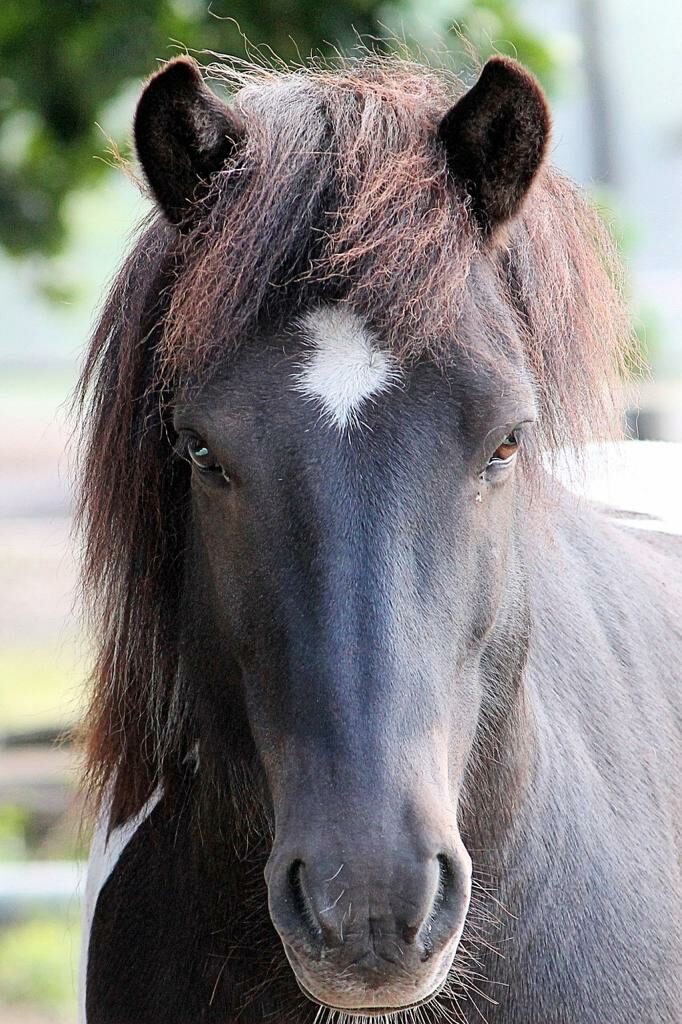
Horse face with happy facial expression

Unlike dogs or cats, for example, horses have no sound for pain. As prey animals, they also try not to show it. This is because an ailing horse would be the first to be attacked by the predator. If a horse is lame, it can therefore be assumed that it has been suffering from pain for a much longer time, but has been able to hide it successfully so far.

For our domesticated horses, this means that we humans often do not even notice that they are not well and train over their needs. Horses are often labelled as lazy, bitchy or stubborn without recognising the actual cause of their undesirable behaviour.
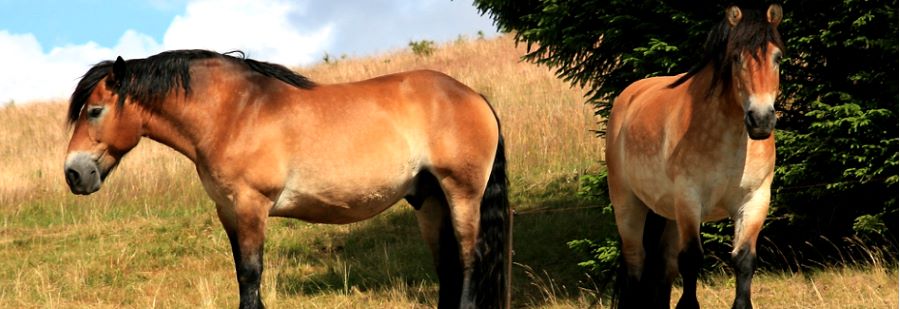
Pain face on a horse in the pasture

Basically, I first assume that riders and horse owners love their animals and do not want to harm them. Therefore, I see the problem in a lack of education and it is a project close to my heart to change something about it. To spread knowledge based on scientific facts without criticising individuals.

Much more, I would like to offer help for self-help. I want to give horse people the knowledge they need to recognise that a horse is not doing well. What they then do with this knowledge is up to each reader.

This is how my e-book “Mimic and Expressive Behaviour of Horses” came into being, which I published at the end of January 2023.

E-book on the expression behaviour of horses

Orders by e-mail to: Laluce@mail.de

Please include name and billing address

Cost: 20€

Format: PDF with 60 pages and over 120 colour photos

E-book on the expression behaviour of horses

Orders by e-mail to: Laluce@mail.de

Please include name and billing address

Cost: 20€

Format: PDF with 60 pages and over 120 colour photos

I also clear up the issue of concentration in my book. Concentration is often used as a justification for recognisable tension in a horse’s face, but in fact it hardly shows at all in the horse’s facial expression. Only the alignment of eyes and ears as sensory organs reveal what a horse is concentrating on at the moment.

Tense chewing muscles, flared nostrils, worry lines over the eyes, earlobes pressed against the base of the skull … All of what is often called a concentrated facial expression by trainers and riders is actually an expression of stress, pain and discomfort.
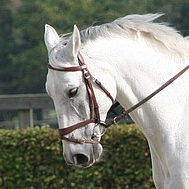
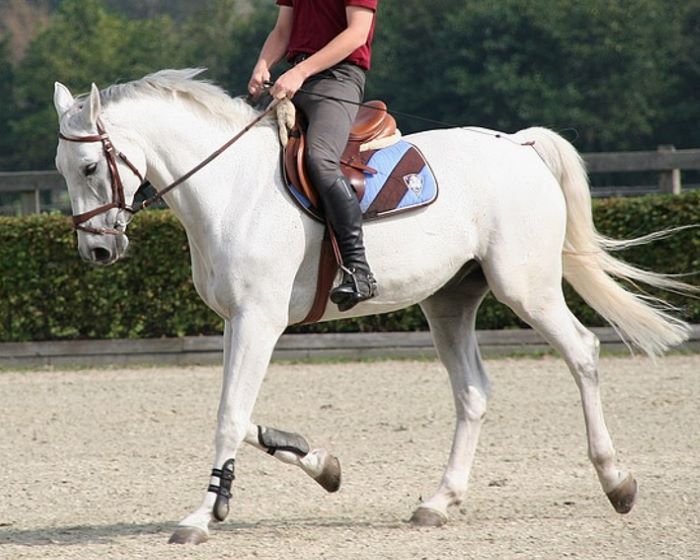
Stress face of a ridden horse

Another problem I see is that the social media, but also photo calendars or posters in the children’s room predominantly depict stressed horses. Why is that? Obviously, the sight of a relaxed, happy horse is too boring for us. Does it always have to be action? Higher, faster, further?

The result: we get used to what we see all the time. Our brain stores the stressed facial expressions as normal and we no longer even notice a horse’s discomfort.

I wish I could encourage more people to question. Perhaps in the future you will consider what you base your assertion on when you say or think that a horse is just fine. What scientifically proven facts confirm this hypothesis?

After all, we all want one thing: for both rider and horse to have fun.

I would like to thank Finn very much for this important contribution to our blog! Even or especially because it can be uncomfortable for many horse owners to face up to it (93%!) and say goodbye to old beliefs, this topic really deserves our attention, because we all want the best for our horses after all.
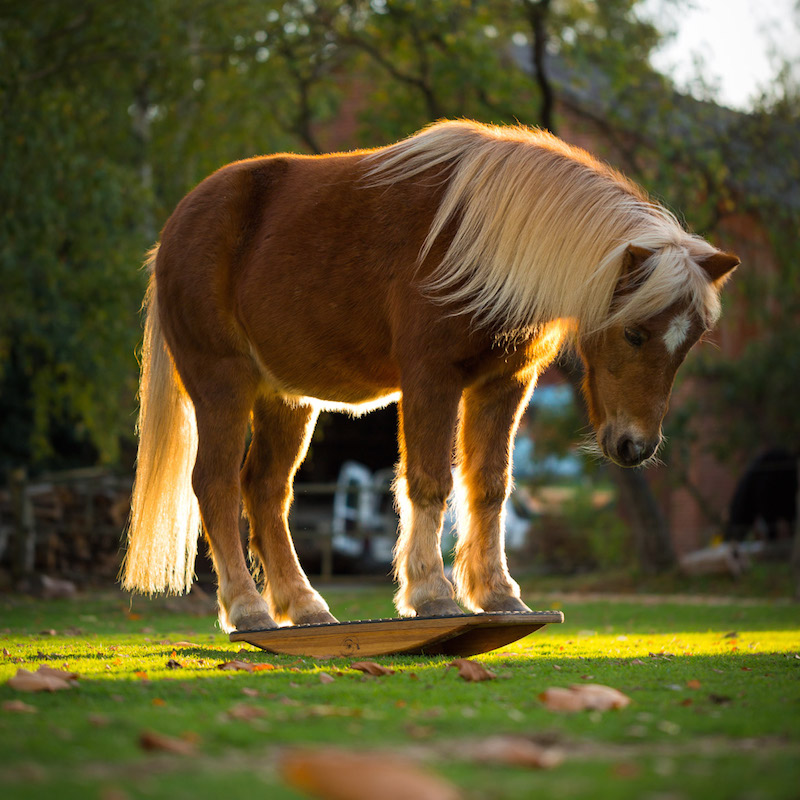
Comprehensive online health course with horse seesaw

In February, the Steigerwald. T seesaw trainer starts as an online course. It is suitable for everyone who wants to take this wonderful full-body workout to a really good level with their horse.

A lot has happened since I invented skid rockers for horses in 2014. Initially dismissed as a crank or a gimmick, more and more horse people are becoming aware of horse rockers.

The advantages are manifold! For example, you can train regardless of ground conditions. The arena is muddy or frozen? No problem with the right Steigerwald.T rocker frame. Are the horseflies pestering you and your horse outside? Train indoors. The small space requirement of a horse rocker compared to what you need for riding, lunging or manual work is a real plus.

In addition, training with horse rockers is suitable for all age groups. A young horse easily and playfully learns to know and consciously move its body. Not everyone can offer their horse varied trails. If it lives on an average paddock and a “normal” horse pasture, sensorimotor stimuli are missing. However, these are important for the development and maintenance of a good body feeling.

A large part of the health problems of horses is related to the musculoskeletal system. Training with horse rockers makes an important contribution to prevention and is used very successfully in rehabilitation.

Recently, a veterinarian reported that horses in the brine chamber on the seesaw are much better at sliming down. Rocker training not only has a positive effect on the musculoskeletal system, but also influences the internal organs. These are partly “suspended” from the spine by fasciae and are gently massaged and activated during rocking.

But how do you get there with your horse? As always in life and in training, many roads lead to Rome and I would like to make it possible for all horse lovers to find out and successfully follow the path that suits their horse with the rocker trainer online course. The biggest challenges are beautiful, flowing rocker wapps and correct hank flexion for the advanced riders.

You can expect the following contents:

  • Prerequisites: Politeness, walk along, stop, stay
  • Moving with feed points
  • single steps forward and backward
  • Moving hooves manually (modelling)
  • Tail and nose target
  • Walk on limited ground
  • Reduce padding and stabilisation
  • Create luffing movements
  • Transitions to independent rocking
  • Extending independent activity to the target: Ten flowing teeter-totter bends
  • Two-legged bob for the forehand
  • Two-legged rocker for the hindquarters
Steigerwald.T-2BW
Steigerwald.T-2BW

An all-round carefree package! Simply everything you need for a healthy and sound training with a horse from the beginning up to the really demanding lessons.

You’ve already bought an existing webinar on rocker training and you’re not sure how much is new? Don’t worry, for one thing: This course is much more comprehensive and special: I personally coach you and your horse on your way. On the other hand: All purchasers of an existing webinar on seesaw training will receive the full purchase price credited to the online course!

Not all details have been finalised yet. However, it is certain that we will limit the number of participants so that I can coach you individually. So if you already know that this is the right thing for you and your horse, take the chance and secure your place for more health and joy of movement: Steigerwald. T seesaw trainer as an online course

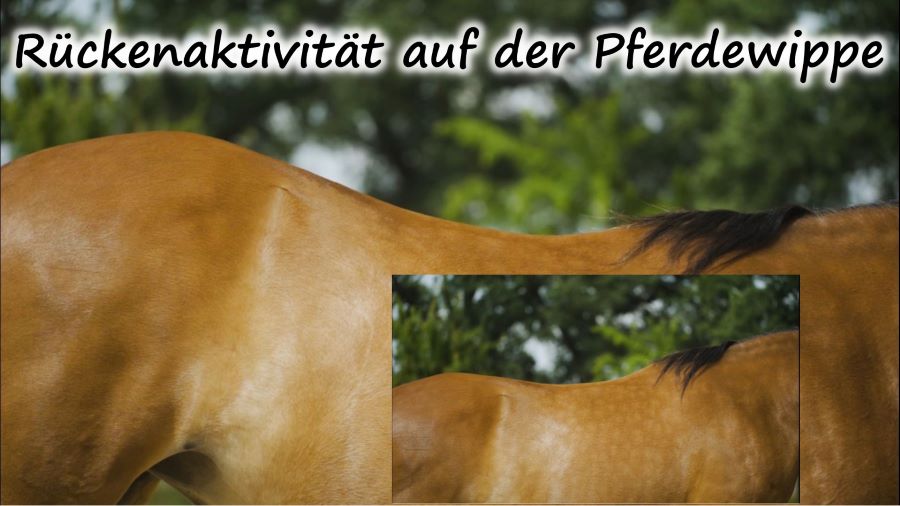
Back activity on the horse rocker

About the courage

That’s pretty brave.” “I admire your courage!

I often hear and read sentences like that. On the one hand, I am happy to receive positive feedback on our emigration, or rather on our decision and the implementation of it, but on the other hand it also makes me think.

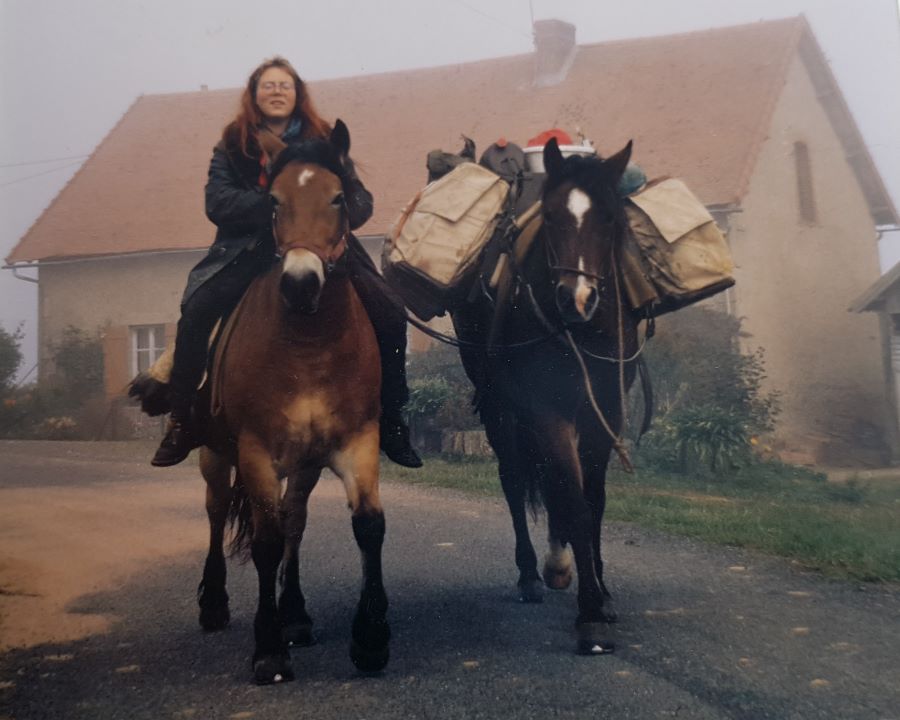
In an interview with the brain researcher Gerald Hüther, I once got to know a somewhat different view of courage itself or of courageous deeds. It is very much in line with my own perception. According to Hüther, people only need courage for deeds they don’t actually want to do. I have always felt that I was not particularly courageous. Not even in 1991, when I rode alone from northern Germany to southern France with two horses and two dogs one month after graduating from high school. It was not a walk in the park for me from a mental point of view. Day after day, steering the horses’ steps towards the south, never knowing what encounters fate had in store for us at sunset. Towards a distant and completely unknown destination. I only knew that I had to do it. Do.

And it’s the same in 2019, when on my first visit to Matou I felt “this is it.”

Nina with two horses on a trail ride from northern Germany to southern France

Have you had this feeling once or several times in your life? Something that occurs not as a wish without an effective will, but as a certainty? Or have you let your life and circumstances develop as they did? Decisions rather always made as reactions to the wishes of others and “society” and circumstances? What does the saying “The world belongs to the brave” mean? Do you own your world?

In this view, one aspect certainly applies. If you want to give me the label “brave woman”, it is true that I have often created a world in my life that was really mine. It belonged to me in a positive sense, it had above-average aspects of life to which I could say “yes!” with all my heart. The fulfilment of none of my dreams elevated me to the mental Olympus. There were many challenges, glaring problems, adversities, but the basic chant was always that of the right film. My world. Because I had chosen it and was willing to bear the consequences of my actions.

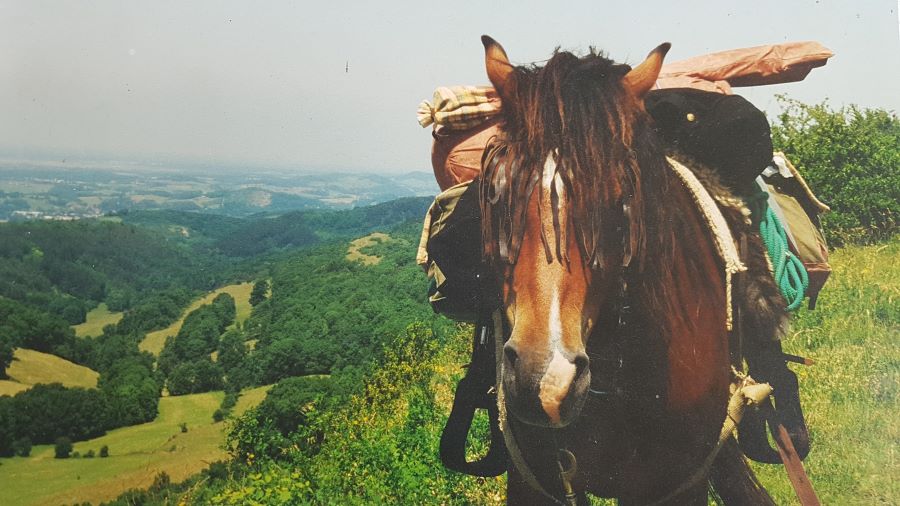
Nina's horse with saddle and panniers on the slope of southern French mountains

A few years ago I attended a lecture by Reinhard Sprenger. He began, “Would you rather be on the beach in Hawaii right now? The good news is that you can be on your way there in a few hours. If you say “I can’t” now, you are just shying away from the consequences. That you’ll be out of a job, your bank account will be overdrawn, your wife will think you’re an a… and your kids won’t have anything to do with you anymore, as an example. But you can go to Hawaii. If you accept the consequences.

The consequences of emigrating to the South of France can be of a similar nature to those Sprenger is talking about. If Mario’s and my move is now called courageous, it could mean that the speaker feels that these kinds of consequences are not bearable for him or her. It would then cost him or her courage to embark on such a path. But what if the consequences are not as bad and serious as feared? What if the positive and good in it carries strongly and nourishes the soul?

If you are thinking about changing something in your life, but you are in the “courage-if-I-didn’t” mode, the following exercise may be helpful for you: Take two sheets of blank paper, write down on one the hoped-for positive consequences of your idea or dream and on the other the feared negative ones. Pay close attention to your feelings as you write and imagine what this step would mean. Weigh and ask yourself again and again: Which is stronger?

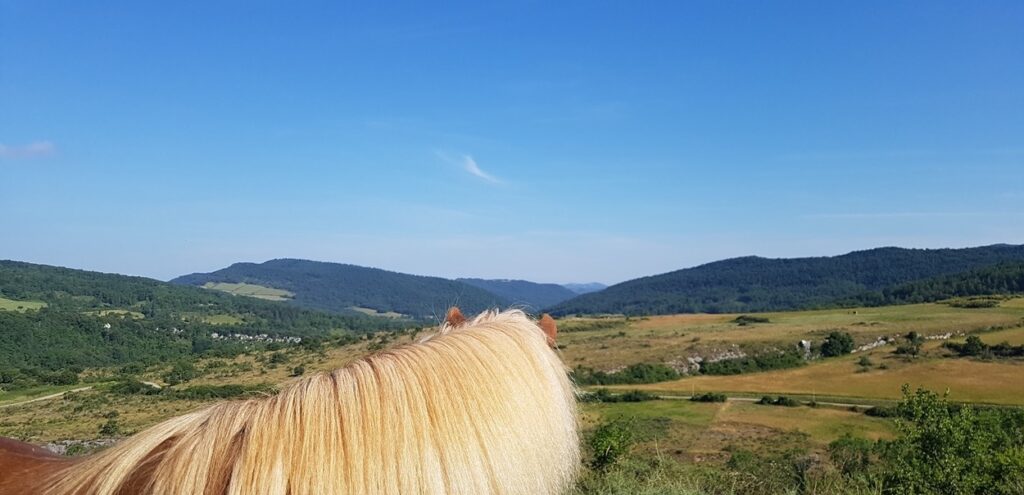
Amadeus keeps a lookout over the mountains of southern France

Sprenger again: “A certain willingness to take risks is the prerequisite for creativity and innovation. Inner motivation arises of its own accord when people do what they do best and what they would voluntarily spend their time doing.

What do you like to do and do well? What do you think you need courage for? These and other questions will be explored during the “Le Matou Experience Week”. An unforgettable stay with body, mental and soul work and of course the six horses and chickens awaits you from March 2023.

Would you like to be part of it? Be one of the first to seize this opportunity? Write me an email and we will talk about your questions, wishes and ideas and who knows, maybe you will find out that this is exactly the right offer for you!

This offer will not be available in the shop for the foreseeable future. It is much more than a further education, it is an invitation into my home, an insight into my world… personal contact comes first. I look forward to hearing from you!

The Motionclick Trainer Network

The Motionclick Trainer Network

Growing together with horses

My colleague Sylvia Czarnecki has launched an initiative: The Motionclick Trainer Network. It is an initiative for trainings based on positive reinforcement as well as for non-violent horse training.

With this we want to contribute to the spread of non-violent training.

“Clicking” is so much more than using a clicker and stuffing the horse with treats 😉

In particular, the network is intended to help people looking for qualified trainers and continuing education opportunities. On the Motionclick Trainer Network page, you also have the option to search for a qualified trainer in your area.

The quality of the trainers is ensured through an admission process based on the Motionclick network guidelines.

Our goal and vision is to promote the understanding of methods based on scientific evidence as well as to make knowledge about these training methods easily accessible and centrally available.

Have you always wanted to learn or start learning about these training methodologies? But you didn’t have the time, or a suitable trainer or information was missing? Or maybe you just want to have a look at the topic?

Terms like “feed point”; “reward rate”, “operant conditioning” you might have heard before but had no idea what they mean in training with horses?

For that, we members of the Motionclick Trainer Network have started an info series on Facebook and Instagram.

Technical terms simply explained. From April 1 to 17, we will explain important technical terms from clicker training in a short and crisp way.

With the series “Technical terms of clicker training simply explained”, you will receive a special technical term from clicker training explained by qualified trainers every day. Since every day a different trainer from the Motionclick trainer network explains a technical term, you have the opportunity to get to know the trainers of the network at the same time.

Through this series of “clicker training terms” and the content of the trainers, you get the opportunity to get a taste of the methodology and training forms, to acquire knowledge in “small bites” and to integrate them directly into your everyday life with your horse, to try them out or to test them.

Here you get high quality knowledge and this for free. So join us and follow us on Facebook and / or Instagram.

And if you should have missed a day, this is not bad. You can also read all the terms or contributions in the aftermath.

On April 18, we’ll wrap it all up with a podcast episode of fair.strength – positive solutions for training with your horse, where we’ll summarize all the terms once again.

We are very happy to offer you with this initiative the perfect opportunity to familiarize yourself with the training form of positivev reinforcement.

Clicker-Trainer list on our Steigerwald.T website

Training with positive reinforcement is finding more and more enthusiastic fans.
For many people it is becoming more and more important to respond to the needs of their horses and to use this form of communication in training or in normal interaction. Some people still strictly refuse to feed a horse at work and then that annoying clicking frog… I felt the same way many years ago. The problem is that sometimes you see real deterrent examples of the use of feed praise. But a method should not be equated with its poor use! Just because there are predatory knights, biscuit monsters, ADHD horses and snapping crocodiles, it does not mean that clicker training automatically leads to these results. This only occurs when serious mistakes are made in timing, signal control, choice of food, criteria, training steps, etc..
For a harmonious path in clicker training it makes sense to have experienced guidance. We all know it from riding: While doing it, you notice, if at all, the mistakes the horse makes. What you could have made smoother, clearer and more understandable for the horse is simply not noticed. That’s what riding instructors are for. Fortunately, there are now more and more Clicker instructors who are there for people and horses in the German-speaking world and offer professional support during training. They have all undergone intensive further training and have dealt with the wide field of “learning” in theory and practice. Some of them are even already in Viviane Theby’s network of TOP trainers. Important courses, in which the training of the human being is in the foreground, are the training specialist for horses, the chicken modules and the seesaw trainer. Since this year the training to become a Steigerwald.T Medical Trainer has been running and the participants have already been able to help many horse-human teams to cope with the respective treatment problems.
To help you and your horse find a suitable and competent companion for your common path in clicker training, we have created a trainer list on the Steigerwald.T site. It is constantly being expanded and supplemented. We are looking forward to a harmonic way together!

clickertrainer

Steigerwald appointments 2021 – exciting seminars

Steigerwald appointments from January to June 2021

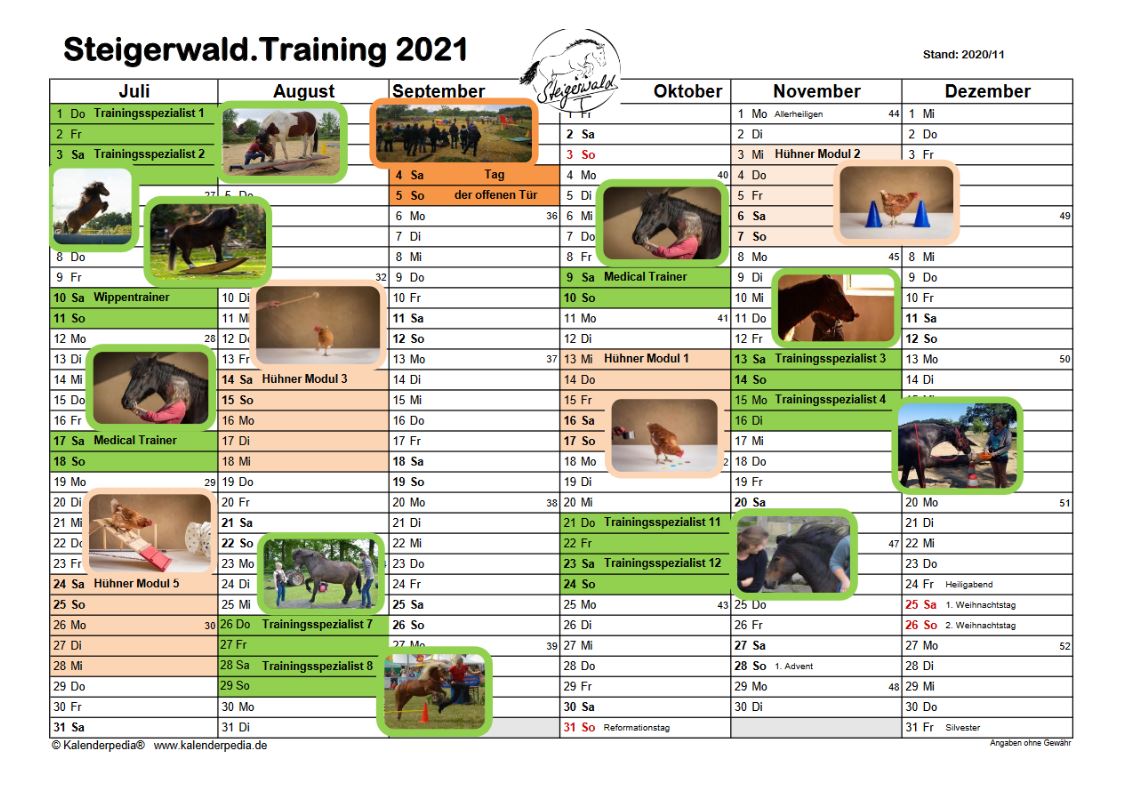
The Steigerwald appointments for 2021 are fixed, can be booked in the shop and are available here as an overview in pdf format for viewing and saving! Our offer is suitable for all people who are interested in a well founded approach to clicker training. For a clear and fair communication with our fellow beings! The proven Chicken Seminars according to Bob Bailey, the Training Specialist for horses, the Seesaw Trainer and Medical Trainer are our training and continuing education offers, which give you a unique access to your animal. Of course there is also a beginners’ seminar Chicken Clicking, because not everyone can imagine what this initially very exotic-looking seminar format is all about. Here you can find a report about chicken training.

As an alternative to face-to-face training, many coaching sessions and lessons 2020 took place in the Online Academy. Except for the chickens, this is a wonderful opportunity to train from home despite distances or other adversities.

We are looking forward to 2021 and also especially to the open day on the first weekend in September when it is time to celebrate 11 years of Hof Steigerwald!

Steigerwald appointments from July to December 2021

Medical Training works wonders in the relationship

How Medical Training has changed our relationship

I’m Katharina Röpnack and Medical Training is what I enjoy most right now.
What sounds like an advertising slogan is actually a very serious one.
To cut a long story short, I am a horse trainer and completed my training as a training specialist for horses with Nina. I am also a rocking trainer and medical trainer in training and have taken part in the chicken camp for beginners.

Besides my cool Shetty Hagrid I have a South German coldblood named Sir Quickly (18 years old). He is a sceptic: “Huuuu, the leaf on the ground could perhaps eat me…”.
Through the clicker training I have already been able to help him build up more self-confidence, develop more curiosity and be brave. So a power box by the wayside is no longer a scary object, but an object worth looking at.

The training with Nina as a medical trainer is totally exciting and full of knowledge to improve your own trainer skills. Simply structured and well thought out. Training on a scientific basis with clear goals. The “class” is friendly throughout and it is great fun to learn together. Due to the pandemic situation right now, the training has changed from face-to-face to online seminars. The big advantage is that I can always look at the recordings of the webinars and coaching sessions.
So in the training we learn how to help horses, owners and handlers to make the examination and treatment as stress-free as possible.
I started the training with motivation. First of all I had to find a co-operator.
What is that … a co-operator?

cooperation tool for medical training

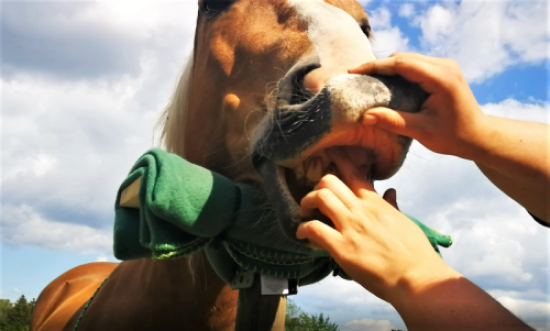
The horse learns to lay the lower jaw branches on a padded board. e.g. on a stand and to keep still. This is the cooperation signal. Only then do I start to perform a manipulation or a stimulus, for example lifting the upper lip.
As soon as the horse moves or raises its head, I stop the manipulation. I wait until the horse puts its head down again and holds still, thus again showing the cooperation signal, and if necessary I apply a weaker stimulus.
If the horse is able to withstand the stimulus/ manipulation, there is click and feed. In this way the horse can communicate with me. It shows its willingness to cooperate and tells me: I am ready.
Or even: “No, I cannot put my head down there. The last step was too scary, uncomfortable or hurt me.”

Surprisingly, my horse linked up very quickly what the job is. Otherwise it usually takes him a long time to process new impulses and trust them.

I never had a big problem with Sir. It was easy to give him a worming treatment, for example, under pressure or he was handy even when he was rinsing his tear ducts. When he injected, he bent one or the other needle, but drawing blood or 20 minutes on the drip, worked.
But my conscience hurt and my pity was very great. I felt that trust was crumbling and that next time his discomfort was greater. I didn’t want to exert any more pressure or compulsion. I did not want to make him feel at the mercy of the situation. If a tiger would voluntarily let himself take blood without sedation… then surely my domesticated horse would be able to do the same.

The medical training with the co-operator has opened my eyes once again with regard to voluntariness and the subject of “endurance” and has paved a way for us to even have fun. Here is an example:

I was ready and could fold up the upper lip of my horse and touch, scratch or tap the gums and also teeth with my finger.E.g. important for the capillary refill time; part of the general examination at the vet.

Now there was a situation where I had discovered a stalk between two teeth and wanted to remove it. So on the one hand, the stimulus lasted longer than the training step actually allowed and maybe it was unpleasant. So he moved his teeth, tongue and mouth and finally took his head from the co-operator. I stopped, of course, but was still full of ambition… the culm now has to get out of there. So I waited for him to take his head off again. Fortunately that happened. So I put my finger on his nose, thumb on his upper lip, lip up and then my finger towards the tooth… and the lip just snapped down. It was a very funny situation and I had to laugh out loud. In Sir’s face you could see that he apparently liked it too, that I was happy. The next time I was allowed to touch the gums with my finger again. But I adjusted the training step accordingly. So really only touch them briefly. Because he had clearly shown me that he felt that the toothpulling was too much for him. During the training session, however, I was still able to remove the stalk by training in small steps. This type of communication is so valuable and important.

Sure, I could have grabbed him by the halter and got the straw out of there quickly… but voluntarily, without holding on, without coercion and with the cooperation of my sceptic, it was worth so much more.

Meanwhile, Sir is muttering and is happy when I set up the co-operator. He really likes the training. Probably because he can decide for himself what he can stand and I listen to him consistently. He is allowed to say “no” and then I just have to think about how to build up the training so that he can say “yes”. And you get better and better. Creative ideas bubble out of my head much faster than before.

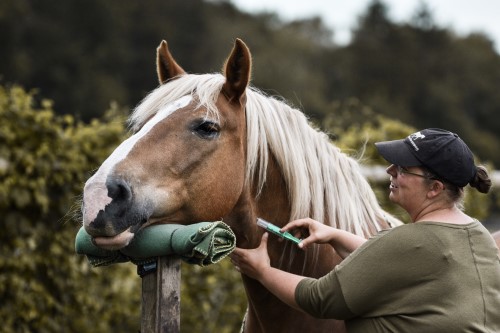
So it happened that during a photo shoot for an article about medical training I started the syringe training without further ado and within 10 minutes he learned to leave his head on the co-operator, I could squeeze the vein and press the syringe (without a needle) to the neck. This was not possible before without tension in the neck, white in the eye, kicks backwards or sideways. And these feelings of happiness make the training so wonderful.

medical training with cooperation tool
injection training with cooperation tool, photo: Lena Kriebel

Small-step training ensures success – success provides motivation and a good feeling. For horses as well as for people.

I can only recommend everyone to get involved in medical training. The horse not only learns how to undergo examinations and treatments without stress, but you also learn a lot about sustainable training and about the limits of each horse. You become creative and learn to help your horse to be a hero without saving it.

Katharina Röpnack
www.motivierendes-pferdetraining.de

Seesaw training international and other seminars

(Deutsch) Termine 2020 auf Hof Steigerwald[en:]dates 2020 at Hof Steigerwald

Now it’s already high summer and the planning of the 2021 dates is in full swing. There have been some important changes for the next seminars in 2020, the good news first:

Due to increased demand, I am holding an English-language seminar on horse seesaw training on October 3rd-4th at Hof Steigerwald. After my presentation “Benefits of seesaw training” at the annual conference of the ABMA in March had to be cancelled, this is a nice opportunity to bring this great topic closer to horse lovers outside the German speaking countries.

Horse seesaw and osteopathy with Antje Wirtz from Pferdereha Friesland will take place on October 24th. A one-day seminar for all those who want to learn more about the effects of bouncing training on the musculoskeletal system of our horses. Which seesaws are suitable for what? Which musculature is used in what? How to train it sensibly? are among other things questions that Antje and Nina will answer clearly.

Chicken module 1, the introduction to another dimension of clicker training, takes place from November 21st-25th. This seminar is open to all people who want to improve their training skills. The proven mixture of theory and practice provides deep insights into the laws of learning.

And now for the regrettable part: Our open house is cancelled. Even though it has always been great to spend the first weekend in September in a spirit of positive reinforcement, we will have to be patient until next year. Then it will be “11 years Hof Steigerwald”, which is also a good reason to celebrate in a very special way.

The Steigerwald.T Online Academy continues to grow and delights and teaches from the comfort of your home computer. The constantly growing offer ranges from “Ninas Basics” to “Delfis Weg” and individual topics such as “Training Plans” to “Training Specialist Horse” and the “Steigerwald.T Medical Trainer”. Check back from time to time, new contents are added regularly and we#re on the way to translate our webinar content into English.

Steigerwald.T at the EQUITANA 2019

We are on tour for you, because …

…the Equitana – one of the most important global horse fairs – will open its doors in Essen for 9 days! We are very happy to help enrich the Equitana with animal-friendly Steigerwald.Training, our equine gymnastics equipment and horse rockers.

In Hall 6 at Equimondi at booth No K29, you are welcome to hammer us with questions, try out our various horse rockers, have a chat about animal-friendly training and any other horse-related topic might be on your mind!

You can watch our live performances at the Cavallo Ring and Hall 6. You will see True Horse Agility and Medical Training with positive reinforcement. Come and see my two own horses, Frieda and Amadeus, showing that they not only have fun at work on their home turf, but also in the unfamiliar surroundings of a show ring. We will also demonstrate that positive reinforcement is an animal-friendly and effective way of training, that can be implemented with any horse – you only have to know how. You can watch us train horses of other trade fair participants that we have never met before – that will be a particularly exciting part, even for me! Thanks again to all the Facebook friends who helped find volunteers for this challenge.

In addition, I really look forward to stimulating round table discussions about dominance with regard to horses. And there will be even more. In the Horse Health Forum you can watch me talk and demonstrate the importance of the cooperation signal.

For times and places please refer to the timetable below or on the Equitana home page.

meet us at the equitana

Upcoming events are online

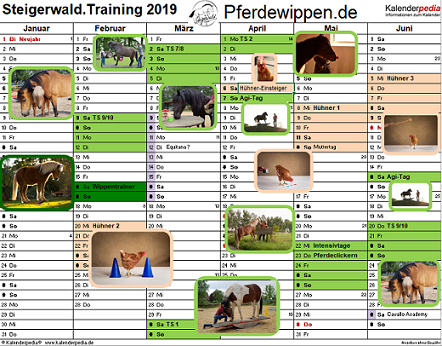
calendar 2019, part 1

What lasts a long time – taking 80th birthdays, important events and everything else into account – is finally going to be good, isn’t it? We proudly present the Steigerwald.Training event calendar 2019! Compact horse clicker clinic, True Horse Agility day, horse seesaw trainer workshop, Medical Training, one-day entry-level chicken camp, the five original Chicken Camps, Open House on the first weekend of September including a True Horse Agility Tournament, the ongoing modules of Training Specialist Horse with a restart at the end of March, featuring the new seminar format “Training Professional Horse”… There are many inspiring events for you to choose from to enhance your training for the benefit of the animals. We look forward to seeing you!
Go to Steigerwald.Events 2019 or browse our web shop at the Steigerwald shop.