The Motionclick Trainer Network

The Motionclick Trainer Network
Growing together with horses

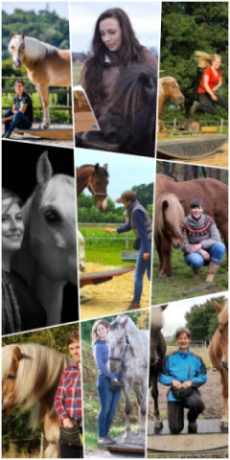
My colleague Sylvia Czarnecki has launched an initiative: The Motionclick Trainer Network. It is an initiative for trainings based on positive reinforcement as well as for non-violent horse training.

With this we want to contribute to the spread of non-violent training.

“Clicking” is so much more than using a clicker and stuffing the horse with treats 😉

In particular, the network is intended to help people looking for qualified trainers and continuing education opportunities. On the Motionclick Trainer Network page, you also have the option to search for a qualified trainer in your area.

The quality of the trainers is ensured through an admission process based on the Motionclick network guidelines.

Our goal and vision is to promote the understanding of methods based on scientific evidence as well as to make knowledge about these training methods easily accessible and centrally available.

Have you always wanted to learn or start learning about these training methodologies? But you didn’t have the time, or a suitable trainer or information was missing? Or maybe you just want to have a look at the topic?

Terms like “feed point”; “reward rate”, “operant conditioning” you might have heard before but had no idea what they mean in training with horses?

For that, we members of the Motionclick Trainer Network have started an info series on Facebook and Instagram.

Technical terms simply explained. From April 1 to 17, we will explain important technical terms from clicker training in a short and crisp way.

With the series “Technical terms of clicker training simply explained”, you will receive a special technical term from clicker training explained by qualified trainers every day. Since every day a different trainer from the Motionclick trainer network explains a technical term, you have the opportunity to get to know the trainers of the network at the same time.

Through this series of “clicker training terms” and the content of the trainers, you get the opportunity to get a taste of the methodology and training forms, to acquire knowledge in “small bites” and to integrate them directly into your everyday life with your horse, to try them out or to test them.

Here you get high quality knowledge and this for free. So join us and follow us on Facebook and / or Instagram.

And if you should have missed a day, this is not bad. You can also read all the terms or contributions in the aftermath.

On April 18, we’ll wrap it all up with a podcast episode of fair.strength – positive solutions for training with your horse, where we’ll summarize all the terms once again.

We are very happy to offer you with this initiative the perfect opportunity to familiarize yourself with the training form of positivev reinforcement.
Steigerwald.T Seesaw-Trainer

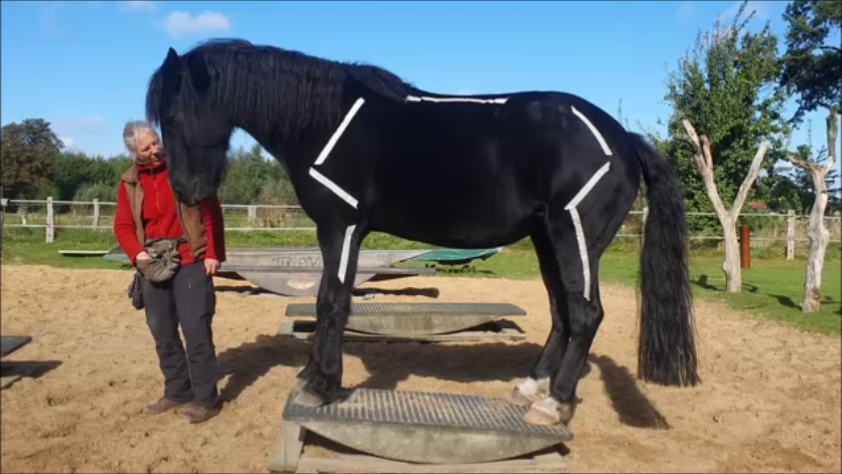
Frieda on the the horse seesaw

The enthusiasm for horse seesaws is growing at an impressive pace. The many positive effects on a wide variety of horses and ponies mean that more and more equids are enjoying the benefits of a rocker. The Steigerwald.T seesaw models can be used in many different ways: Even simply stepping on or over them promotes the work of the deep muscles and is a real challenge for the coordination skills. However, if you want to achieve the best for your horse, it is worth working towards independent, flowing “seesaws”. This activity strengthens the muscles and, most importantly, gently softens the fascia. To do this, your horse shifts its weight rhythmically back and forth. And please do all this without bending the joints or using the neck.
Teeter training is complex, training teeter-totters requires good timing and a certain amount of practice. And this is where the Steigerwald.T seesaw trainers come into play: they guide you and your horse to muscle training with fun and understanding. To receive the certificate, practical participation on a weekend at Hof Steigerwald is a prerequisite. On both days, all participants train with horses of different levels of knowledge. From stepping on a confined surface to first instability, creating rocking movements, independent rocking wapps to Hanken flexion, everything is included. So you not only get a comprehensive picture of the structure and procedures in teeter-totter training, you also learn practically which pitfalls to avoid and what to change if things don’t go as planned. And that is quite often the case with horses in real life ? .
Then it’s a matter of training two “journeyman horses” and documenting the training by video and writing. Regine Witten from Plus-R Pferdtraining met the challenge with flying colours with two Icelandic mares. You can find the training sequences for 10 bobbing wapps for a click as well as from the first step to the hank bend on Youtube.
This year, Simone Mender from Simones Pferdetraining and Nadine Senekowitsch from Positv Fairstärkt have fulfilled the requirements and help interested and committed people train with the horse seesaws. We are very happy that even more horses will be able to enjoy seesaw training and congratulate them!

Medical Training with the help of a co-operator

A ‘co-operator’ can be a great help in training. I came up with this expression because horses can show cooperative behaviour with this device. Furthermore, it is incredibly practical, especially when checking and caring for your horse’s teeth – at least in the incisor area – that your horse’s head rests on the ground. What’s the point of it all, isn’t keeping still enough? Of course, complete immobility is only our “invitation” to the horse to become active at all and to perform the respective training step or stimulus. In my opinion, however, it makes a difference if a voluntary motor movement is carried out which is otherwise never done by your horse and which ALWAYS has the consequence of a stimulus. That this stimulus should always be such that your horse can respond to it by holding still and then being strengthened with click and feed is of course the basis of the training. With the decision “I put my lower jaw branches on the pad” your horse also chooses the following consequences of this action. Therefore I like to work with cooperation signals and cooperation behaviour.

Which conditions should a co-operator fulfil?

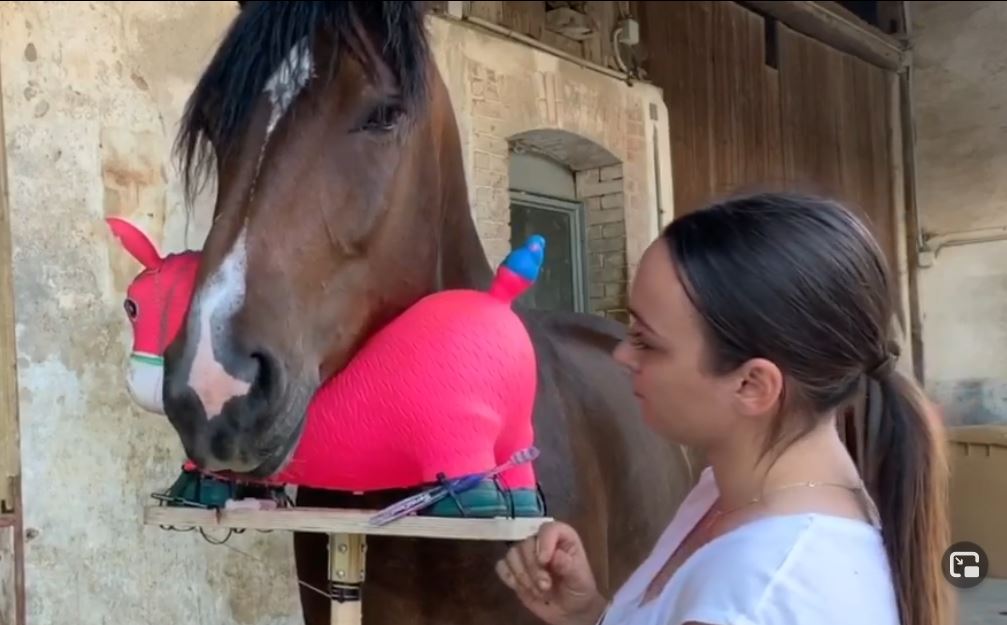
  • You need a comfortable support for the horse’s head. If you take a gate or a piece of the fence, you can simply wrap a blanket or the like around it. Selina Köstl, a participant in the Medical Trainer training group, has taken a rubber horse. I myself use a lumbar cushion of the office chair, so there are no limits to your imagination. Whether the co-operator cushion should be raised at the side – I don’t know exactly. An advantage is a clearer recognition of the centre for horse and man. A disadvantage can be that you cannot reach the head so well from the side.
  • A simple variation in height is highly recommended! Depending on what you want to train and with which horse – if you have several – even 20cm can make a huge difference for the cervical spine of your horse. In the following video I show how a too high cooper can have an effect on the muscles.

  • Stability is elementary! Especially if you have misjudged your horse’s stability, it is possible that your horse leans on it a bit more and pushes forward. It may also be possible that the lower jaw branches pull the contact surface towards him. Remember that enormous leverage is at work! For me, the worst thing would be to work on building up trust and then this object would flap around and in the worst case it would hit the horse!
  • The same applies to “protection against penetration”. We have equipped all our stainless steel horse rockers with this, even if it is not relevant for the statics. Horse legs have a life of their own! At the operator this means: There must NOT be a longitudinal or transverse strut in front of the front legs in such a way that your horse can get stuck with its hoof or fetlock bend in the event of a scratching or frightening movement! With the sack barrow I prefer, you can simply screw a thin plate in front of it. If you use scaffolding trestles, make sure you cover them up!
  • If you are training with a halter, nothing should stick out of the co-operator in such a way that a part of it can get caught between the horse’s head and halter. Remember that even horse heads do not always move as desired. So make sure all corners and edges are well protected.

In the video below I show the construction of the sack barrow operator based on an idea by Maike Klein.

If you want to learn the use of cooperation signals in a well-founded way, I can warmly recommend the corresponding webinar from the Steigerwald.T Medical Trainer training series.
Now I hope you enjoy doing handicrafts and training! Let us help the horses to feel safer in this world.

Example of a co-operator as a comfortable support for the horse's head

Clicker-Trainer list on our Steigerwald.T website

Training with positive reinforcement is finding more and more enthusiastic fans.
For many people it is becoming more and more important to respond to the needs of their horses and to use this form of communication in training or in normal interaction. Some people still strictly refuse to feed a horse at work and then that annoying clicking frog… I felt the same way many years ago. The problem is that sometimes you see real deterrent examples of the use of feed praise. But a method should not be equated with its poor use! Just because there are predatory knights, biscuit monsters, ADHD horses and snapping crocodiles, it does not mean that clicker training automatically leads to these results. This only occurs when serious mistakes are made in timing, signal control, choice of food, criteria, training steps, etc..
For a harmonious path in clicker training it makes sense to have experienced guidance. We all know it from riding: While doing it, you notice, if at all, the mistakes the horse makes. What you could have made smoother, clearer and more understandable for the horse is simply not noticed. That’s what riding instructors are for. Fortunately, there are now more and more Clicker instructors who are there for people and horses in the German-speaking world and offer professional support during training. They have all undergone intensive further training and have dealt with the wide field of “learning” in theory and practice. Some of them are even already in Viviane Theby’s network of TOP trainers. Important courses, in which the training of the human being is in the foreground, are the training specialist for horses, the chicken modules and the seesaw trainer. Since this year the training to become a Steigerwald.T Medical Trainer has been running and the participants have already been able to help many horse-human teams to cope with the respective treatment problems.
To help you and your horse find a suitable and competent companion for your common path in clicker training, we have created a trainer list on the Steigerwald.T site. It is constantly being expanded and supplemented. We are looking forward to a harmonic way together!

clickertrainer

InterHorseFair – 4 weeks 3D online horse fair

InterHorseFair 2020

On the 11th of December the InterHorseFair opens its virtual doors for the first time.
An online horse fair…… Who would have thought it possible? This time last year I would at least not have expected to be represented online at horse fairs. The live fairs were too nice. The contact with people, the expert discussions and the exchange among like-minded people. I have always enjoyed these times very much. In 2020 everything will have gone differently than planned for most of us.

Out of necessity, Arien Aguilar and his team launched an online horse fair in spring, in a very short time. With an overwhelming response! I think it is fair to say that it was a complete success. Looking, shopping and training from the comfort of your own home is very trendy. In my opinion, the huge advantage of an online horse fair is that it is horse-friendly! No transport stress, no tight, loud boxes in full stable tents and no noise in the exhibition hall itself.

Now, many online congresses, challenges, online workshops and zooms later, the digital possibilities seem more and more familiar to us and we have come to appreciate this option.

From 11.12.-08.01.2021, the Equimondi team has once again provided the equestrian world with the opportunity to watch a veritable firework display of great trainers, workshops and demonstrations from the comfort of their own homes. Very comfortable without having to travel, searching for a parking space and queues in front of the ticket office. You can book your ticket here.

Of course we at Hof Steigerwald are part of the event. Our themes: Horse seesaws, True Horse Agility, Medical Training and learning behaviour/clicker training.

I will also be speaking about Medical Training at the 1st international virtual CONGRESS ON EQUINE HEALTH.

Will we see and hear each other?

speakers of the congress on equine health

Steigerwald appointments 2021 – exciting seminars

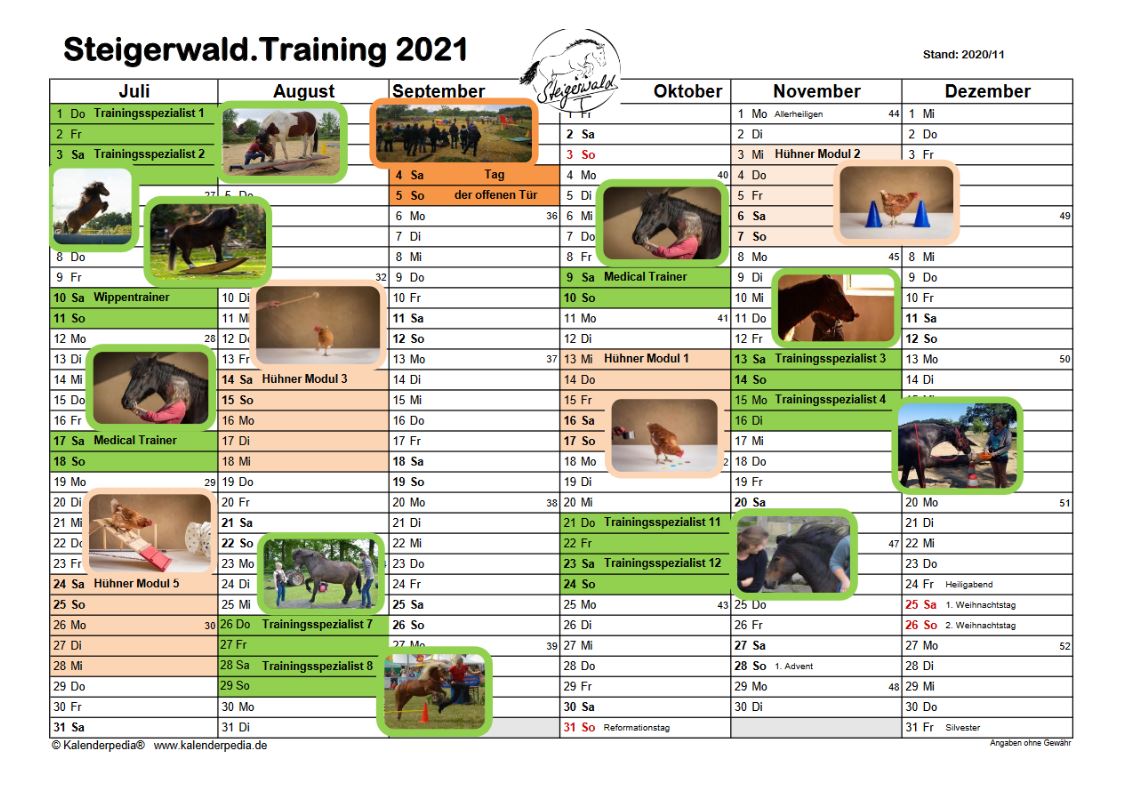
Steigerwald appointments from January to June 2021

The Steigerwald appointments for 2021 are fixed, can be booked in the shop and are available here as an overview in pdf format for viewing and saving! Our offer is suitable for all people who are interested in a well founded approach to clicker training. For a clear and fair communication with our fellow beings! The proven Chicken Seminars according to Bob Bailey, the Training Specialist for horses, the Seesaw Trainer and Medical Trainer are our training and continuing education offers, which give you a unique access to your animal. Of course there is also a beginners’ seminar Chicken Clicking, because not everyone can imagine what this initially very exotic-looking seminar format is all about. Here you can find a report about chicken training.

As an alternative to face-to-face training, many coaching sessions and lessons 2020 took place in the Online Academy. Except for the chickens, this is a wonderful opportunity to train from home despite distances or other adversities.

We are looking forward to 2021 and also especially to the open day on the first weekend in September when it is time to celebrate 11 years of Hof Steigerwald!

Steigerwald appointments from July to December 2021

Medical Training works wonders in the relationship

How Medical Training has changed our relationship

I’m Katharina Röpnack and Medical Training is what I enjoy most right now.
What sounds like an advertising slogan is actually a very serious one.
To cut a long story short, I am a horse trainer and completed my training as a training specialist for horses with Nina. I am also a rocking trainer and medical trainer in training and have taken part in the chicken camp for beginners.

Besides my cool Shetty Hagrid I have a South German coldblood named Sir Quickly (18 years old). He is a sceptic: “Huuuu, the leaf on the ground could perhaps eat me…”.
Through the clicker training I have already been able to help him build up more self-confidence, develop more curiosity and be brave. So a power box by the wayside is no longer a scary object, but an object worth looking at.

The training with Nina as a medical trainer is totally exciting and full of knowledge to improve your own trainer skills. Simply structured and well thought out. Training on a scientific basis with clear goals. The “class” is friendly throughout and it is great fun to learn together. Due to the pandemic situation right now, the training has changed from face-to-face to online seminars. The big advantage is that I can always look at the recordings of the webinars and coaching sessions.
So in the training we learn how to help horses, owners and handlers to make the examination and treatment as stress-free as possible.
I started the training with motivation. First of all I had to find a co-operator.
What is that … a co-operator?

cooperation tool for medical training

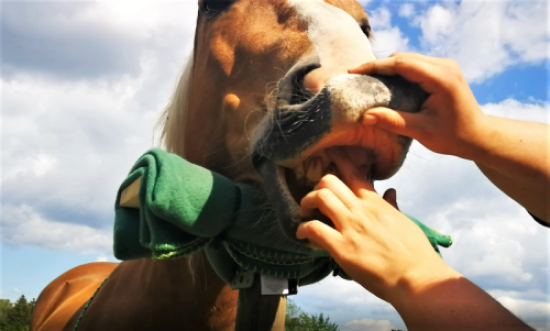
The horse learns to lay the lower jaw branches on a padded board. e.g. on a stand and to keep still. This is the cooperation signal. Only then do I start to perform a manipulation or a stimulus, for example lifting the upper lip.
As soon as the horse moves or raises its head, I stop the manipulation. I wait until the horse puts its head down again and holds still, thus again showing the cooperation signal, and if necessary I apply a weaker stimulus.
If the horse is able to withstand the stimulus/ manipulation, there is click and feed. In this way the horse can communicate with me. It shows its willingness to cooperate and tells me: I am ready.
Or even: “No, I cannot put my head down there. The last step was too scary, uncomfortable or hurt me.”

Surprisingly, my horse linked up very quickly what the job is. Otherwise it usually takes him a long time to process new impulses and trust them.

I never had a big problem with Sir. It was easy to give him a worming treatment, for example, under pressure or he was handy even when he was rinsing his tear ducts. When he injected, he bent one or the other needle, but drawing blood or 20 minutes on the drip, worked.
But my conscience hurt and my pity was very great. I felt that trust was crumbling and that next time his discomfort was greater. I didn’t want to exert any more pressure or compulsion. I did not want to make him feel at the mercy of the situation. If a tiger would voluntarily let himself take blood without sedation… then surely my domesticated horse would be able to do the same.

The medical training with the co-operator has opened my eyes once again with regard to voluntariness and the subject of “endurance” and has paved a way for us to even have fun. Here is an example:

I was ready and could fold up the upper lip of my horse and touch, scratch or tap the gums and also teeth with my finger.E.g. important for the capillary refill time; part of the general examination at the vet.

Now there was a situation where I had discovered a stalk between two teeth and wanted to remove it. So on the one hand, the stimulus lasted longer than the training step actually allowed and maybe it was unpleasant. So he moved his teeth, tongue and mouth and finally took his head from the co-operator. I stopped, of course, but was still full of ambition… the culm now has to get out of there. So I waited for him to take his head off again. Fortunately that happened. So I put my finger on his nose, thumb on his upper lip, lip up and then my finger towards the tooth… and the lip just snapped down. It was a very funny situation and I had to laugh out loud. In Sir’s face you could see that he apparently liked it too, that I was happy. The next time I was allowed to touch the gums with my finger again. But I adjusted the training step accordingly. So really only touch them briefly. Because he had clearly shown me that he felt that the toothpulling was too much for him. During the training session, however, I was still able to remove the stalk by training in small steps. This type of communication is so valuable and important.

Sure, I could have grabbed him by the halter and got the straw out of there quickly… but voluntarily, without holding on, without coercion and with the cooperation of my sceptic, it was worth so much more.

Meanwhile, Sir is muttering and is happy when I set up the co-operator. He really likes the training. Probably because he can decide for himself what he can stand and I listen to him consistently. He is allowed to say “no” and then I just have to think about how to build up the training so that he can say “yes”. And you get better and better. Creative ideas bubble out of my head much faster than before.

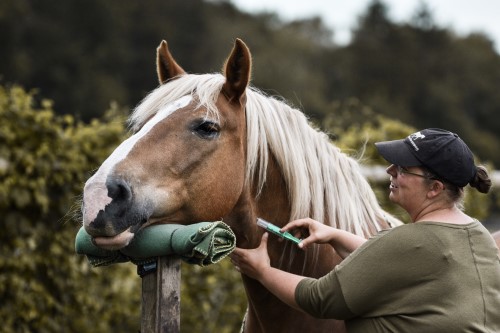
So it happened that during a photo shoot for an article about medical training I started the syringe training without further ado and within 10 minutes he learned to leave his head on the co-operator, I could squeeze the vein and press the syringe (without a needle) to the neck. This was not possible before without tension in the neck, white in the eye, kicks backwards or sideways. And these feelings of happiness make the training so wonderful.

medical training with cooperation tool
injection training with cooperation tool, photo: Lena Kriebel

Small-step training ensures success – success provides motivation and a good feeling. For horses as well as for people.

I can only recommend everyone to get involved in medical training. The horse not only learns how to undergo examinations and treatments without stress, but you also learn a lot about sustainable training and about the limits of each horse. You become creative and learn to help your horse to be a hero without saving it.

Katharina Röpnack
www.motivierendes-pferdetraining.de

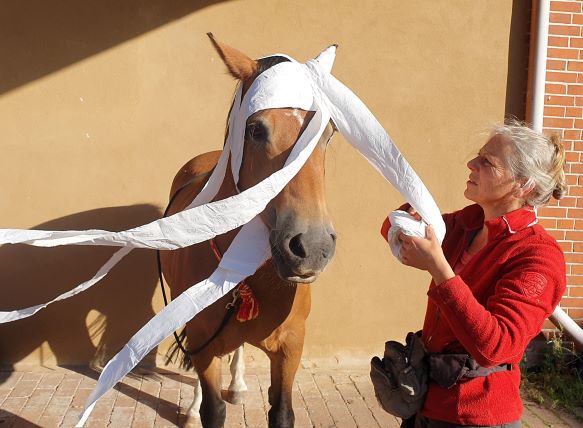
Toilet Paper Challenge meets Medical Training

Toilet paper around horse head

Luckily my horses had never injured themselves that much, that they needed a bandage. Last year however Wolfgang had a corium inflammation and needed a hoof bandage.. In a practical way you do that with a nappy and an armored tape. The noice alone, while tearing off the latter, causes many horses rather wanting to leave the place of  happening. But luckily Medical Training exist! If we practice with our horses in advance, that standing still is worthwhile, even when weird things are wrapped around the body, then everything is quite easy in case of emergency.

Do you also want to put a bandage on your horse in a relaxed way? Then take part in our free toilet paper challenge.? ? ⭐️#KlopapierChallenge meets Medical Training⭐️ ? ?You need: ✅ toilet paper✅ a horse✅clicker & feed✅ a(cellphone)camera✅ fun.

What looks like a pure pastime fun action at first sight, is a wonderful training field for positive reinforcement and Medical Training the second look. Running time: You’ve got three weeks to train. Let us participate in your training with videos in the Facebook group „Medical Training for horses with Nina Steigerwald“, ask questions, exchange ideas and have a look what others are posting.

The prizes for the winners will be announced around August 15th. We will state the exact date  the week before. The prizes:  1st – 3rd prize: one webinar each of your choice from the Steigerwald.T-Online-Academy (worth 59€)?4th – 6th prize: once one webinar each from the series: Ninas Basics (worth 29€) The requirements: ? At least wrap the toilet paper around  head  neck  belly  and one leg  10 times, while your horse stands still – all feet stay on the ground for the entire time  you feed your horse yourself? the less clicks the better?Extra points: The toilet paper stays in one piece –without crack ☝?- ? even more extra points: roll up the paper again at the horse’s body, because of waste avoidance and  further use. Will you take part? Then let’s take off together.

? Free Facebook group “Medical Training for horses with Nina Steigerwald”:
? Online-Academy: Training animal-friendly | horse bouncing | true horse agility | clicker training | medical training
? Shop Training & Therapy Equipment
Community: Are you already a member of our free Facebook group? If not, feel yourself warmly invited to join!