The road and arrival in France

I have never experienced such a busy July in my entire life:

At the beginning of the month, the last seminar at Hof Steigerwald with a good portion of melancholy that the time at this wonderful place has its end, the eighteenth birthday of our son, then the clearing and packing marathon, another flea market, parallel to this already the first construction work of the new owners. Preparing the ponies for the long trip on the truck. The planned start date was constantly postponed because it became clear that we would not be able to pack everything up and move it.

Great friends supported us and then on July 27th it was finally time. From 07:00 in the morning until 22:00 in the evening we packed and cleared and then loaded the ponies.

Those who have been to Hof Steigerwald before will fondly remember the birch trees at the access road. Unfortunately, they were cut to horse trailer height, but not to truck dimensions… Anyone who has ever been in a trailer that drove along bushes knows what an unpleasant noise that makes.

We had specially bought our own horse trailer, because we had special requirements for the long trip with our small herd. For example, we wanted to be flexible in terms of date and time of day: This also proved to be spot on with the heat and the chaos of the preparation! Then the shetties needed compartments appropriate to their size to travel safely and comfortably. And of course, most importantly, we needed training time with the -in the meantime- yearlings.

Such a long distance means unloading and reloading, after all we have to make enough breaks for all fellow travelers. That means at least twice everyone has to get back into the van in good spirits. I have accompanied enough human-horse teams to know: The truth always shows up at the next inquiry after the ride. So it was a matter of extensively “loading up” the truck in a positive way. Around the adults I worried less, they have enough travel experience to climb also again with me into the swaying and rolling cave.

In order not to begin the journey immediately with the creepy strip of the branches and twigs of the birch trees, we decided to load on the access road – which we had trained only once before. In the meantime it had also become quite dark, my adrenaline level was relatively high, but everything worked out flawlessly.

Then Mario left with the 814 and the eight-meter trailer, and I followed behind with the Sprinter and the small five-meter trailer. Unfortunately, the camera for the horse area, which was purchased specifically for the trip, only worked when the engine was off, but there was no rumbling or pounding, everything was very quiet. So we rolled through the night, into a new life, leaving behind a very fulfilling one.
First stage and first break at the Scheuerhof of Viviane Theby

The first stage ended at Viviane Theby in the Eifel. She had warned me in advance that there would be a construction site in the village in front of them. This the Navi also indicated and guided us down from another highway exit. Only to then indicate on a country road, “You have reached your destination. You have 350 meters to walk.” So it was a case of finding our own way along the country lanes. Turning around twice because we missed driveways, then a hairpin turn a kilometer away from Viviane. So we unhitched the trailer from the truck and drove on without it, so that the ponies could finally get out after eight hours of driving.

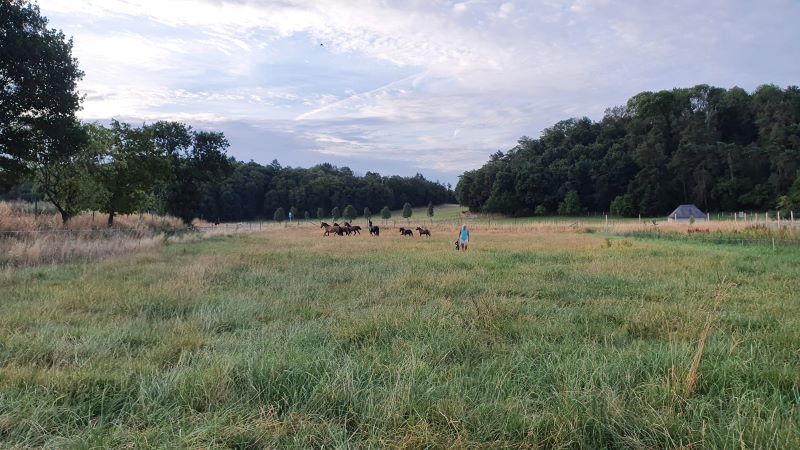
They came to a meadow with beautiful grass despite the dryness and were clearly thrilled. Now it was time for a break!

We had planned a day, a night and another day to regenerate for everyone and we wanted to continue traveling at night. It was wonderfully relaxing to be at the Scheuerhof, admiring the agroforestry strips, eating pizza from the clay oven, and having good conversations. Also, on the side, Mario repaired the alternator regulator and a broken cable on the truck.

Friday evening at 9:30 p.m. the ponies all dutifully boarded their “rolling home”, but Elvis and La Vida would not back up into their compartments on hand signals. I was very sorry to pull on the halter, but fortunately that went flawlessly.

Another emotional goodbye came when we passed the border. Now we were no longer on our way to France as vacationers, now we came as new residents of the country. The 530 kilometer drive to a good bit before Lyon was also flawless. If you disregard gas stations that do not accept the card for payment or truck drivers who also honk when overtaking the slow team on the mountain… We still savored the sunrise, then the next destination was reached.
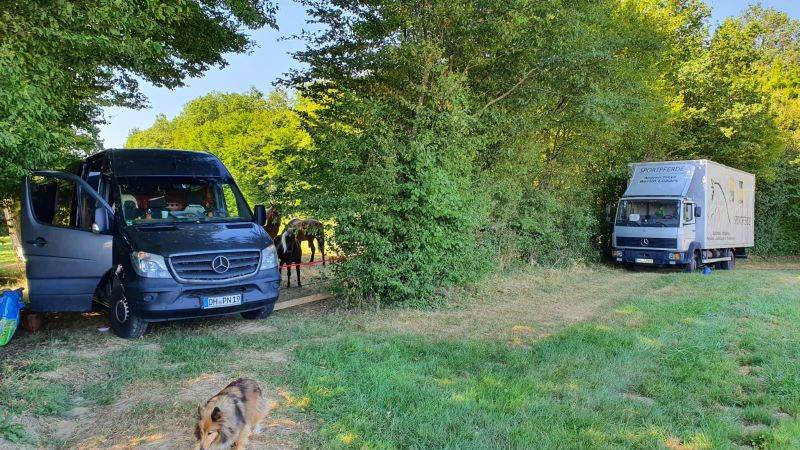
Break for people and animals in the shade of the trees

At the “Camping Terre Ferme”, which is idyllic but only 10 minutes from the highway, we were warmly welcomed in the morning.

After unloading, Freya and Elvis galloped me first over a stubble field and I held the other four ropes and prayed that I would manage to calm the excited four others and that they would come back soon. Which, thankfully, they did!

We were then able to make ourselves comfortable with everything in a tree-lined meadow, built a portable fence for the ponies, and opened a bottle of champagne before settling into the sprinter to recover from the night’s ride.

The two 36 hour long breaks helped a lot in processing this rather intrusive move. Even though we were really looking forward to France and the life on Le Matou, the soul also wants to be able to come along. It is not said for nothing that one should not travel faster than a swallow flies.

During the 3rd loading, the yearlings unfortunately had to be coaxed into their compartments with pressure in front of their chests. Understandably, they didn’t feel like the consequences of “parking” anymore, but then, as soon as the breast bar was hooked, they were calm and made no attempts to go against it.

The heat is even greater in the south; the stretch down the Rhone Valley was still twenty-five degrees in the middle of the night! Fortunately, as we turned inland it got better and even after sunrise we were only at twenty degrees.

Freeway exit: after a few kilometers the breathtaking view of the Pyrenees. Tears of gratitude and relief flowed. Gurgle over land, excitement grows. Five kilometers before Matou park the long trailer at the neighbor’s, two kilometers on a narrow road, park the truck, unpark the ponies, Elvis first drinks at Freya. Then we walk the rest of the way to our new home, Mario follows on his bike.

Because of all the stress with the four excited ponies in hand, I unfortunately can’t enjoy it as much as I would in a romantic vision of this situation. Checking the paddock fence, releasing the ponies, crying. But then, “Honey, we’re really there, we made it!”

As I write these lines, we are already five days in this incredibly wonderful area, enjoying nature and silence, the vastness, the mountains and the good feeling to have made the right decisions.

If you want to have some info about Le Matou, have a look at the previous blog post: Steigerwald.The Dream: Our new home in France
Steigerwald.T Dream: Our new home in France

“Why on earth would you leave a farm that you have lovingly built up over twelve years with a lot of heart and soul?”

Because it was simply time.

There are different types of people, and one possible division is into builders, keepers and breakers. Mario and I are definitely builders. The sooner you know in which area your strengths and fulfillment lie, the better you can live according to yourself. This is one of the keys to happiness in life.

There is still a lot to build on our property in the south of France, although we will take it a little easier this time. The total area is 67 hectares, 46 of which are mixed forest with oaks mainly and there is also an area of beech. I love the young greenery in the spring when the sun shines on it!

Sixteen hectares of meadows, half of which are already fenced for horse safety, and a couple of hectares of scrubland complete the offer for our ponies. My wish is a trail or walking and riding path once around the whole area, which would make it about six to seven kilometers round trip. A wonderful feature is the location. In the south, the border is mainly a creek. Here we will make accesses for the ponies to drink. Rising in the north, the entire southern slope to the ridge in the north then belongs to Le Matou, the residence is centered at five hundred meters.

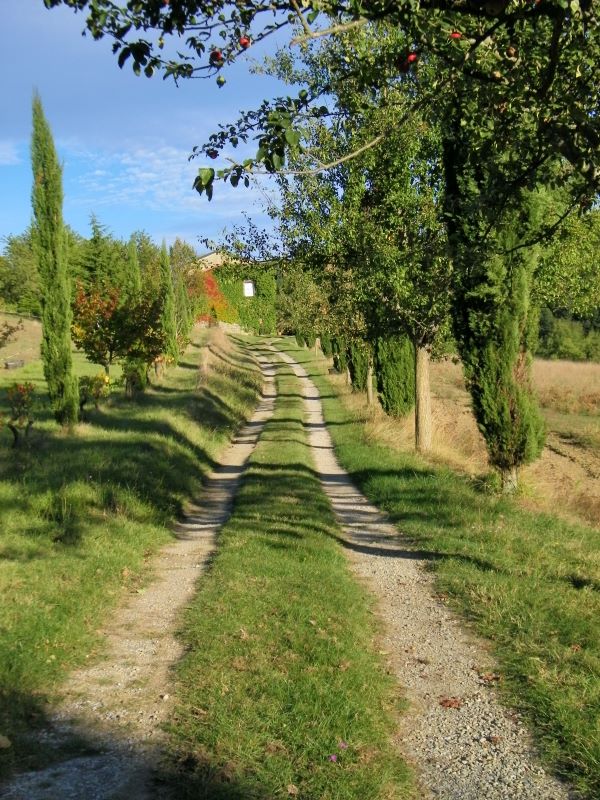
The idyllic driveway to the new home

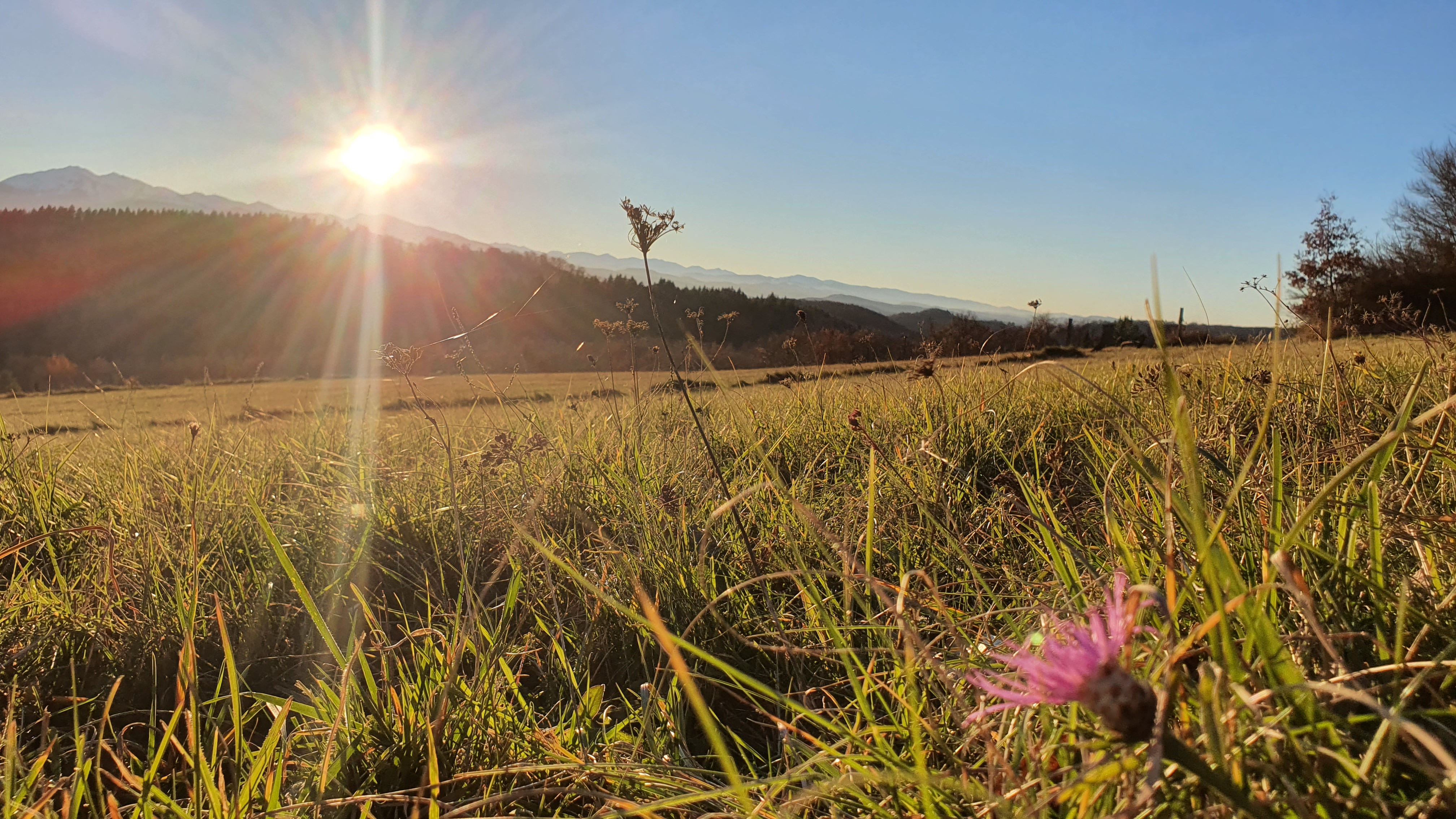
The summers are not quite as hot as at the sea and the winters not as cold as “properly” in the mountains. Perfect! What also excites me very much is the length of the day in winter. A whole hour more light in the morning and evening! But the greatest thing is the breathtaking view of the Pyrenees from some places on the property.

For the ponies there are two open stables made of wood, which we only have to cover with strips of curtains or windbreak nets. And that’s it with the existing outbuildings. That’s why we put up a round-arched shed last winter. It will function as a barn, carport and storage.

From the buildings we are downsizing a lot, but fewer roofs, gutters, windows, cleanable and sweepable area can definitely be seen as an advantage.

The guest house with its twenty square meters is located about 30 meters from the main house and is freshly renovated. From 2023 it will be available for vacationers, educational leave on Le Matou.

Mario and I have 54 square meters available for living in the main house. Above there is again the same area as a shell. Here we could well imagine a seminar room. The right wing is a shell. Bare stone walls and a fortunately intact roof. One part will be a workshop or storage, whether the other will be a living area or not is still up in the air.

What guarantees us a lot of peace and quiet is the location at the end of a five-kilometer-long dead-end street. One kilometer the access road leads nicely up to the house already over the own area, after that is end. The nearest neighbor is 500 meters away as the crow flies, but there is forest in between. Even if he would start his lawn mower every day, it wouldn’t matter!

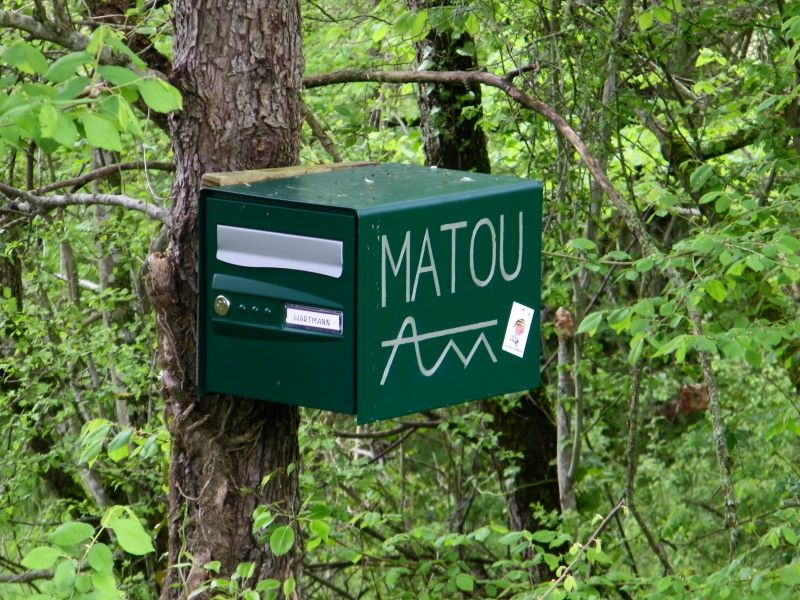
A mailbox on a tree in southern France soon contains Steigerwald's mail

In the next post about the south of France, I’ll report on our trip there and how we got there. The plan is to do the 1600 kilometer route in three stages with a day’s rest in between each.

And now, full of anticipation mixed with farewell pain, I will continue packing and clearing, in a few days we are heading for the final tour with the ponies.

Horse Seesaws: Which size fits?

What are the questions that horse people who are concerned with sensible gymnastics through seesaw training ask? Of course, a lot is about how to get the horse to move on the seesaw in such a way that his musculoskeletal system gets the greatest possible benefit from it. But before the beautiful muscles can sprout, the right size of seesaw has to be chosen. In our seesaw shop

we offer the so-called full-body seesaws. We created the name because, on the one hand, the whole horse’s body is trained on it and, on the other hand, there is usually not much more space on such a seesaw than for a whole horse’s body.
In the seesaw shop there is a size finder that is based on the horse’s stature, but I would like to address a few other important factors.
An easily measurable parameter for the right horse rocker is the so-called “wheelbase.” There are square and rectangular types of horses, which come in different lengths for the same stick size.
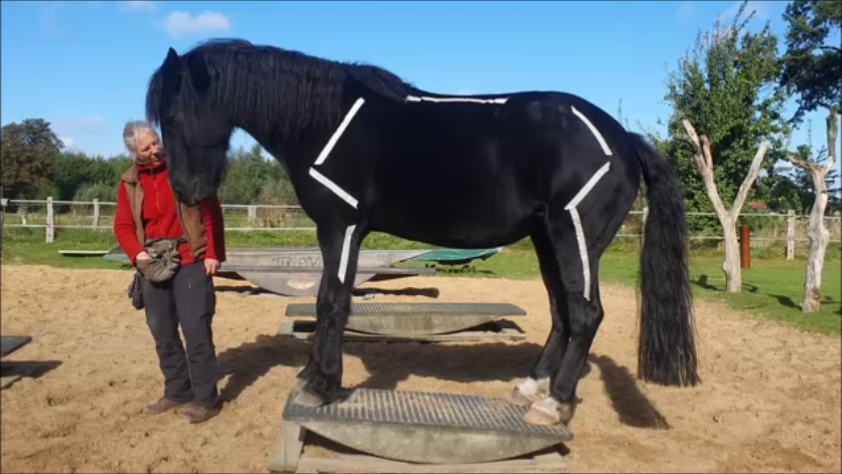
To determine the wheelbase, I recommend the following procedure: You stop your horse from moving and measure the length from the tip of the front hoof to the ball of the equilateral hind hoof. Then let your horse walk a few steps, stop again and measure again. After five measurements, take the cut and find the length your horse needs for full body rocking.

Now, many equids often lie exactly on the border between two rocker sizes. We offer them in 1000, 1250, 1500 and 2000 millimetres length in the footprint. This is also the reason for the product designations, e.g. T-1500 of the Steigerwald.T horse saddles.
What if your horse has a wheelbase of 160 centimetres? Of course it can also bob nicely on a Steigerwald.T- 1500, if it puts itself together a bit there. But it can only bob in this way, because there is simply not enough room for all the other positions. The particularly beneficial effect of the loose swinging on muscles, fasciae, tendons, ligaments and joints cannot be achieved in this way. The reason for this is that your horse has to build up and maintain a certain tension in order to be able to stay on the reduced and unstable support surface at all. The stretching, relieving component of the “teeter-totter” movement is therefore considerably less.
Of course, the “rocking mountain goat” is a great workout and a real eye-catcher especially for people who find it hard to believe that you can get horses on such training equipment at all. Anyone who has ever sat on a horse’s back and felt the different types of seesaws will confirm that there is a lot of tension in the whole body when it pushes itself together on the little horse seesaw.
That’s why I recommend a larger size when choosing a horse rocker. You can place your horse sometimes more open, sometimes more closed, sometimes slightly sawhorse-like like a rocking horse, sometimes more at the front end, sometimes more at the back end of the seesaw. And then you have a much greater variance in the strain on the muscles.
Then, of course, there is the question of how old your horse is, or whether he has physical problems such as spavin or problems with his spine. In this case it makes sense to make the task easier for such a candidate.
Especially stepping on the seesaw is easier if there is more space. This also applies to horse-human teams that do not have much experience with ground work or clicker training. An experienced trainer can set the horse tricky tasks such as a shire on a two-legged see-saw with fewer mistakes and more success.

If the seesaw is to be used more on a trail and for riding over, the T-2000 is a good choice. Due to the longer overhang, it has a fixed end for stepping on and off. This allows horses that need to balance the rider in addition to their own body to move safely into instability. It is approved for up to 800 kilos in wood and up to 1000 kilos in stainless steel and can also be managed by less experienced teams with a little practice.
After all, gymnastics training should be gymnastics with fun! If the tasks are easy to understand and manage, especially at the beginning, the joy is greater on both sides. In the Steigerwald.T Online Academy you can find great webinars on seesaw training (LINK) and there are now some seesaw trainers who can help with questions.
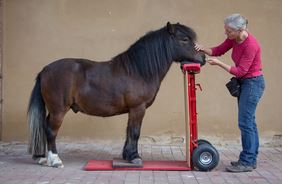
But back to the size of the seesaw. Horses are known to be herd animals and it is possible that several horses share a rocker. The following applies here: Smaller equids can move any size of see-saw, my two Shetty geldings with their 100 and 105 centimetres of stature and 102 and 98 centimeters wheelbase respectively can move all horse seesaws well up to the T-3000. If you have a pony with a wheelbase of 115 centimetres, for example, it will be able to perform versatile seesaw training on a T-1500 or T-2000. A big advantage of a larger footprint horse rocker is that you can rock up and down together with your horse. There are three variations:
1. you let yourself move and let your horse do all the work.
2. you move your horse. This is wonderful for loosening up his muscles and strengthens your hindquarters 😉
3. you find a common groove of alternating activity and passivity. A wonderful way to move together with your horse!
There is no right and wrong, every seesaw moves differently, every hoof length change in position changes the whole balance structure. For transport, I always recommend using a handcart. This is a good way to move all the seesaws from A to B on your own and is easy on the back.
Whichever seesaw you choose and whichever one you are already using, enjoy the valuable training time you spend together with your horse!

Cooperation in medical training

nina horse injection coopertation

Today I would like to explain the topic of cooperation with horses in medical training and give you an insight into this form of training.

What does cooperation mean in dealing & training with horses?

“Uncertainty and helplessness versus self-determination”.

In many situations in everyday life with our horses we depend on the cooperation, trust and participation of our horses. In the life of a horse there are some scary or frightening moments and unknown situations. A very special unpleasant and difficult situation for many horses is the treatment at the vet.

It is tied up, possibly in pain. You, as his confidant, are agitated. In addition, there is the veterinarian, whose presence has often been associated with less than pleasant experiences for your horse in the past.

Your horse finds himself in a situation where he knows that he is in for acutely unpleasant measures and possibly also pain. The tension level rises and with it the stress hormones. Your horse’s instinctive behavior would be to flee or fight back. However, the more tense the muscles, the more intensely it will feel pain. Your horse is stuck in a vicious circle and the horse’s brain stores the situation under the heading “acutely bad”. Consequently, in the future, when it thinks it perceives indications of a comparable situation, it will react with defensiveness from the outset.

An animal-friendly way out of this vicious circle is to give your horse a say and control over the course of a treatment. In this way, he can actively give you his “okay”, knowing full well that it may become uncomfortable in a moment.

Your horse gets a say & self-determination and is willing to cooperate with you and the veterinarian. In other words, it cooperates and actively collaborates.

What goals do you achieve with this?

When we have worked out this willingness to cooperate in the horse, many fear and fright moments for your horse can be avoided. He does not store the visit & treatment of the veterinarian negatively and a possibly before always necessary sedation or nose brake is no longer necessary.

The bottom line is that everyone involved wins: your horse regains its self-determination, you gain more security and a smooth process, the vet gains an enormous reduction in workload and everyone together gains much more confidence in dealing with each other.

In addition, medical training does wonders for the relationship between you and your horse. Please have a look at this blog Medical Training works wonders in the relationship.

How you can develop this willingness to cooperate in your horse?

For exactly this development of cooperation and self-determination there is the so-called “Medical Training”. I have developed a whole training concept for horse owners, trainers, veterinarians and other professionals in the equine field.

This training is especially focused on health care and veterinary situations. You will learn methods to practice certain scary and frightening situations like the injection, a worming treatment, etc. and take away your horse’s fear of them.

In my Steigerwald.T -Online Academy, you will find a variety of educational content in the form of webinars under the section Medical Training.

With which you can build and develop this cooperation!

In medical training we work with cooperation signals.

A cooperation signal is a behavior established through reward learning that gives you information about your horse’s willingness to endure and even actively cooperate with subsequent manipulations.

The main use for cooperation signals is in the area of grooming or medical procedures. They enable your horse to control the course of such measures.

Thanks to the self-efficacy thus achieved and the positive link established through the training path, your horse can learn to endure the often uncomfortable, unpleasant or even painful procedures in the treatment in a calm and relaxed manner.

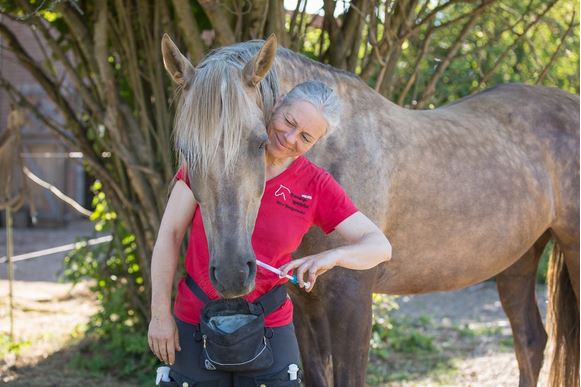
Examples of cooperation signals include assuming a certain posture or performing body targets with or without aids.

The most commonly chosen cooperation signals include:

  • the basic position
  • a hoof target (ground target)
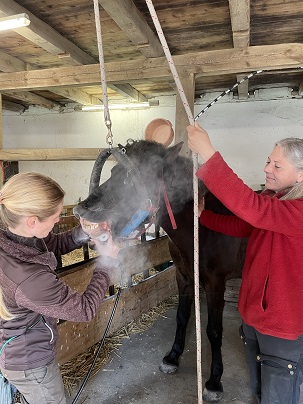
  • lower jaw target on a cooperator (see photo)
  • stationary nose target
horse cooperation

There are many other cooperation signals, supporting tools and exercises in medical training.

If you want to learn more about Medical Training and get a taste of it, I have something for you in my store. The free webinar “Introduction Medical Training”.

In this webinar with me and veterinarian Samantha Krost-Reuhl, you will learn about the basics of medical training as well as the contents of the Steigerwald.T Medical Trainer training. In addition to the theoretical background, you will get an overview of the various possibilities of application on the horse as well as first ideas for your training at home.

In order to deepen and concretize these first ideas for the training as well as for your concrete questions, there will be the live webinar Cooperation in (Medical) Training | Live Webinar on 12.07.2022 at 19:30. Here you can register directly.

Variety in training with horse rockers – The rotary plate

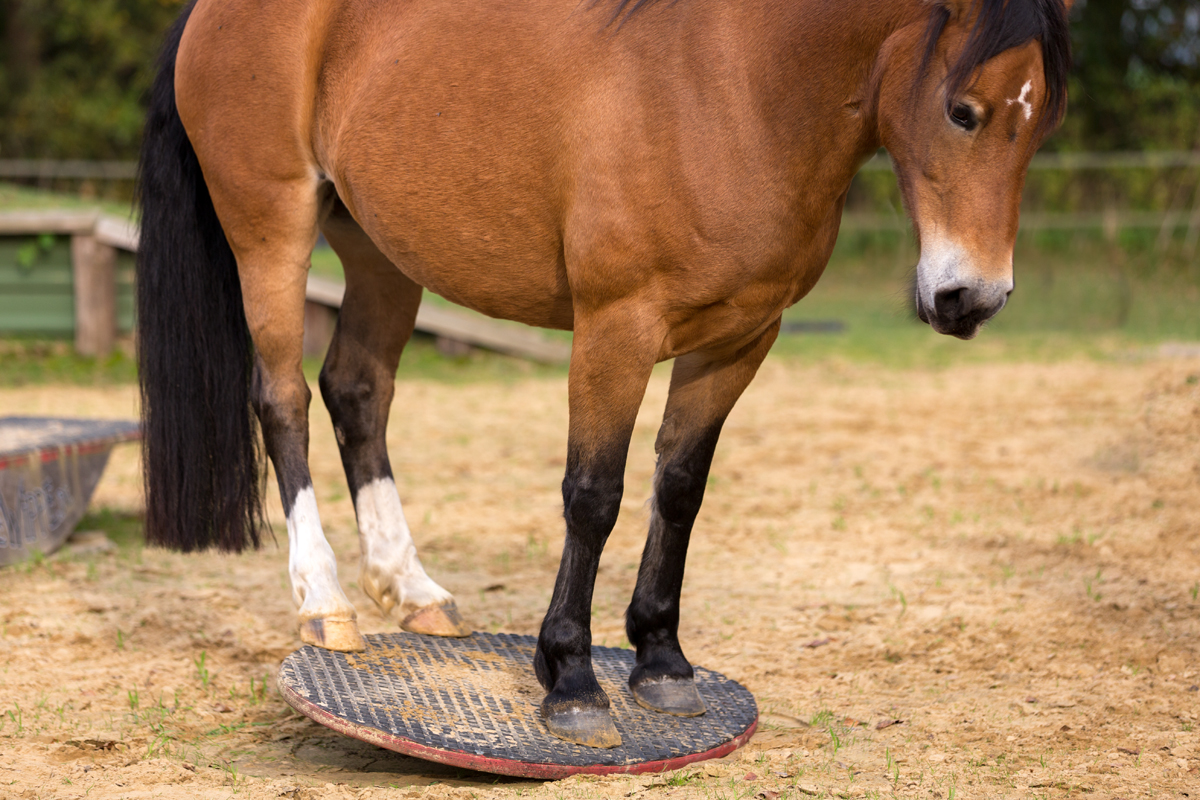
With this blog I would like to introduce you to the Steigerwald.T turntable as well as its advantages for health-promoting horse rocker training.

A Steigerwald.T horse rocker in round or oval offers endless training possibilities for a full-body workout.

I have been using this innovative therapy aid and training device for many years. My very first turntable consisted of the edge of an old wagon wheel on which I had screwed planks and a rubber mat. From the bottom there was a stable screw supported by a hemisphere.

The second was made from an old cable drum from civil engineering 😅. In the meantime, we have practical and more manageable ones at our Steigerwald.T horse rocker shop.

On it, every movement opens up new incentives for more health through conscious movement. Fitness, mobility, safety – the turntable offers endless possibilities.

The charm lies in the variable simulation of tilting movements, which provoke corresponding balancing movements. A turntable can be used in as many ways as few other gymnastic equipment for horses.

  • Trains the deep muscles as well as the core muscles in the abdomen and back
  • Improves strength endurance
  • Develops cognitive and sensory-motor skills
  • Improves coordination skills and thus surefootedness
  • Strengthens concentration
  • Creates flexibility in the brain through new movement patterns
  • Perfect physical preparation for trailer rides
Variety in training with horse rocker

You should definitely introduce your horse to instability in small steps. After all, it has to cognitively process what you want from it. On the other hand, the many small muscles along the spine have to get used to their new task.

As preparation and for the introduction, I recommend my course “Starting with seesaw training” and then, building on this, the live webinar on training with the turntable on 30.05.2022.

In training you can encourage your horse with several options after getting used to it:

The compass needle: Your horse turns on the spot. Hoof by hoof, it finds its footing on the limited surface – or not, as each repositioning changes the entire balance structure. In this way, it learns to move on a small, unstable surface and to stabilize itself at the same time.

The rocker: Due to the absence of runners, you only have to be careful that there are no unsightly pock-pock impact moments. But if your horse stands on only one half of the turntable, you can train nice, even swinging back and forth. The same applies to rocking from left to right.

The king’s way: Your horse shifts his weight from the back to the front, to the right, to the back, to the left, to the front again… And this in a fluid loop, so that part of the outer edge always keeps contact with the ground and there are no floating moments. None of mine have got that far yet. But you have to have goals too 😉 .

The Shaker: Through a hula-hoop-like movement coming from the entire torso, the plate rotates a bit on its hemisphere. The plate is in a hover for a moment, but moves to one side. The longer the shake provides the rotational movement, the better.

The Buddhist: Your horse keeps the plate in balance as long as possible so that the outer edge does not touch the ground.

In this video you can see different training options with the turntable.

Would you like to teach your horse these highly interesting movements? The live webinar for the brand new training will already take place on 30.05.2022 at 19:30. Secure your place and register here.

Don’t dream your life…

TDon't dream your life

Part 1 – Le Matou – How it all began

What about your goals, wishes and dreams? Do you have a list of places you would like to visit one day, of experiences like walking with a herd of wild horses, of a very specific attitude towards life? Is there something you are specifically doing to get closer to it? For me, a long-held dream was to live on a farm with many animals and to have a seminar center. The realization began in 2010 with the purchase of a remaining farm in Lower Saxony.

We planned and worked, built and designed and received a lot of support from the universe and countless dear people. Over the years, Hof Steigerwald grew and thrived into an oasis for people and animals with a busy schedule. And why on earth would you give up something like that?! It wasn’t actually planned that way either.

In 2019, I finally wanted to take a real vacation in the summer again and browsed Airbnb. Since I had gone after the Abitur with two horses and two dogs on a five-month trail ride in the foothills of the Pyrenees and had lived there for 1.5 years, I also looked there for offers. Finally, this area had never completely let me go. The nature, the silence, the charm of the mountains, the relaxed attitude towards life….

I enjoyed every day of my vacation, reminisced about times gone by, and when my hostess told me about a uniquely beautiful place that was for sale due to age, I said, “Well, I’d look at it…”. The day before heading back to Germany, we drove to Le Matou, the name of the farm. In France, every individual farm has a proper name, which is very charming. Walking around the property I saw the Pyrenees and felt: this is it! ❤

No ifs, ands or buts, it practically jumped out at me. However, I had no idea where I would get the money and what my husband Mario and Richard, our son would say about it. Both thought I was crazy, of course. Correctly and completely crazy. A very exciting time followed and in April 2020 we sold Hof Steigerwald and bought Le Matou. At the end of July it finally happened and our dream became reality.

We move with Sheltie Jupiter and all six ponies. Richard stays in Germany to do his Abitur, the sheep are already housed somewhere else and the chickens move to the new location for the chicken seminars near Göttingen. Because there will still be me as a speaker in Germany! Due to family and friends, there are enough reasons besides teaching expert clicker training to get me on the road three-four times a year.

The horse seminars do not yet have a definite location as of October. In any case, I will work exclusively on farms with reasonable open stables. Fortunately, formats like the Steigerwald. T Medical Trainer or the Training Specialist Horse you don’t need a whole indoor riding arena.

For the seesaw trainer, on the other hand, you do need a bit of a selection of gymnastics equipment on site, as I won’t be bringing the seesaws from France.

So if you already own some Steigerwald gymnastics equipment and would like to have two seminars a year on the topic of horse rocker training at your yard, please contact me at info@steigerwald-zum-testen.anke-kirschenmann.com.

Apropos horse seesaws: The construction and shipping of everything from the two-hooves-rocker to the whole-body-horse-rockers to the rotary-disc-horse, balancer-beam and stepper will continue to take place in Germany. However, the wood of the runners will then be southern French.

With the time there will be also seminar offers there, on Le Matou.

We are already busy planning and the guest house is already ready for occupancy. On the 67 hectare property, the possibilities are endless! And for the women, who are thinking about how to convince their husbands to travel so far for advanced training: Mario wants to get a mini-excavator for all the work that still needs to be done, so the needs of many are taken care of 😉

More details about Le Matou will follow in the coming weeks. Subscribe now to our newsletter, then you will not miss any news and you can continue to follow our dream and especially the launch on Le Matou.

And now we take you a little bit with us and introduce you to Le Matou with the video.

The Heroes List

The list of heroes is a list of helpers and supporters who support us in making the Le Matou dream come true.

We would like to thank all those who have supported us so far and continue to support us in making the Steigerwald dream come true.

We are grateful and happy about every single supporter and wish our special helpers all the best for the realization of their own life dreams.

Would you also like to be on the list of heroes and be there when, in the face of the Pyrenees, a place is created where living, loving, learning is made possible? Then choose your own personal thank you for your contribution in our online store.

The Motionclick Trainer Network

The Motionclick Trainer Network

Growing together with horses

My colleague Sylvia Czarnecki has launched an initiative: The Motionclick Trainer Network. It is an initiative for trainings based on positive reinforcement as well as for non-violent horse training.

With this we want to contribute to the spread of non-violent training.

“Clicking” is so much more than using a clicker and stuffing the horse with treats 😉

In particular, the network is intended to help people looking for qualified trainers and continuing education opportunities. On the Motionclick Trainer Network page, you also have the option to search for a qualified trainer in your area.

The quality of the trainers is ensured through an admission process based on the Motionclick network guidelines.

Our goal and vision is to promote the understanding of methods based on scientific evidence as well as to make knowledge about these training methods easily accessible and centrally available.

Have you always wanted to learn or start learning about these training methodologies? But you didn’t have the time, or a suitable trainer or information was missing? Or maybe you just want to have a look at the topic?

Terms like “feed point”; “reward rate”, “operant conditioning” you might have heard before but had no idea what they mean in training with horses?

For that, we members of the Motionclick Trainer Network have started an info series on Facebook and Instagram.

Technical terms simply explained. From April 1 to 17, we will explain important technical terms from clicker training in a short and crisp way.

With the series “Technical terms of clicker training simply explained”, you will receive a special technical term from clicker training explained by qualified trainers every day. Since every day a different trainer from the Motionclick trainer network explains a technical term, you have the opportunity to get to know the trainers of the network at the same time.

Through this series of “clicker training terms” and the content of the trainers, you get the opportunity to get a taste of the methodology and training forms, to acquire knowledge in “small bites” and to integrate them directly into your everyday life with your horse, to try them out or to test them.

Here you get high quality knowledge and this for free. So join us and follow us on Facebook and / or Instagram.

And if you should have missed a day, this is not bad. You can also read all the terms or contributions in the aftermath.

On April 18, we’ll wrap it all up with a podcast episode of fair.strength – positive solutions for training with your horse, where we’ll summarize all the terms once again.

We are very happy to offer you with this initiative the perfect opportunity to familiarize yourself with the training form of positivev reinforcement.

Steigerwald.T Seesaw-Trainer

Frieda on the the horse seesaw

The enthusiasm for horse seesaws is growing at an impressive pace. The many positive effects on a wide variety of horses and ponies mean that more and more equids are enjoying the benefits of a rocker. The Steigerwald.T seesaw models can be used in many different ways: Even simply stepping on or over them promotes the work of the deep muscles and is a real challenge for the coordination skills. However, if you want to achieve the best for your horse, it is worth working towards independent, flowing “seesaws”. This activity strengthens the muscles and, most importantly, gently softens the fascia. To do this, your horse shifts its weight rhythmically back and forth. And please do all this without bending the joints or using the neck.
Teeter training is complex, training teeter-totters requires good timing and a certain amount of practice. And this is where the Steigerwald.T seesaw trainers come into play: they guide you and your horse to muscle training with fun and understanding. To receive the certificate, practical participation on a weekend at Hof Steigerwald is a prerequisite. On both days, all participants train with horses of different levels of knowledge. From stepping on a confined surface to first instability, creating rocking movements, independent rocking wapps to Hanken flexion, everything is included. So you not only get a comprehensive picture of the structure and procedures in teeter-totter training, you also learn practically which pitfalls to avoid and what to change if things don’t go as planned. And that is quite often the case with horses in real life ? .
Then it’s a matter of training two “journeyman horses” and documenting the training by video and writing. Regine Witten from Plus-R Pferdtraining met the challenge with flying colours with two Icelandic mares. You can find the training sequences for 10 bobbing wapps for a click as well as from the first step to the hank bend on Youtube.
This year, Simone Mender from Simones Pferdetraining and Nadine Senekowitsch from Positv Fairstärkt have fulfilled the requirements and help interested and committed people train with the horse seesaws. We are very happy that even more horses will be able to enjoy seesaw training and congratulate them!

Physical pain and its impact on behavior

Frekjas first treatment

I am Svea and currently the trainee at Hof Steigerwald.

Frekja is an Icelandic mare and 14 years young, I bought her in April 2020. She has a lively personality and used to have explosive reactions out of nowhere. Many of her actions were blamed on Frekja’s character. Even I never questioned it. When I started to train her differently with Nina and she was accustomed to the herd, the “overshooting” was noticeable and we thought about ways to help her. We tried to get Frekja more in balance with a Bach flower therapy and good training. But somehow there was a permanent tension in my horse that was just normal to me. That was Frekja. An explosive horse. Physical causes for behavior did not occur to me.
The previous owner had her teeth checked every year. Apart from a few edges, nothing was ever discovered. Last year, on her scheduled dental check-up date, we were going to Hof Steigerwald. “No problem,” I thought. “Nothing has ever been discovered, so it’s okay if the check-up is after 1.5 years and not after one as usual.”
In May, Rebecca Pflug came for her dental appointment. I was really excited because I’ve never seen anything like this and I’ve never experienced a sedated horse. But Rebecca was great and after a few minutes into her treatment she discovered something not so good in my horses jaw: the upper first, right molar tooth was split transversely. A broken tooth in my horse’s jaw! That was the first shocking surprise. One possible cause: The first lower molar teeth on both sides were too long and had therefore put too much pressure on the upper ones. On the left side it was not sure if the first upper molar tooth was also broken or if it was just a wolf tooth that had placed itself strangely. In any case, it was clear: the broken tooth has to be removed.

Okay, what now? Since my horse doesn’t go well on a trailer, I wanted to hike back to Hamburg with her. The trip was planned for the end of May/beginning of June. One tooth has to be pulled, that’s only a small intervention, not that big of a deal for most horses, so maybe it can be combined? On the way home, we stop at the Ottersberg clinic, take a little break to recover, and keep on hiking. That was the plan. A crazy plan, but I’m still young and therefor still allowed to make such plans.

The operation was on 1 June. On the third day of our trip we arrived at the clinic and my horse was sedated straight away, because she didn’t feel comfortable in the treatment room and without sedation the first examination of the teeth wouldn’t have been possible.
It soon became clear that both teeth were broken. The other supposed to be wolf tooth was part of the molar tooth that had been broken into three pieces. After the X-ray, the next surprise: On the right side, there was a granuloma above the broken tooth. According to the vets, this nodular, inflammatory collection of cells had been growing for about 2 years. For this period of time a flammable process had been going on in my horse’s mouth, making the two teeth unstable and dissolving the roots. My horse must have been in more or less severe pain for at least a year. The surgery was scheduled for 1.5 hours.

Unfortunately, I was not allowed to be present during her operation. I was completely exhausted and organised a pick-up service for us, as it was no longer possible to walk any further. At 12 o’clock sharp I was standing in front of the treatment room, the trailer was already there and I am still incredibly grateful for my host Ulrike for her support and how warmly she took Frekja and I in.
The two of us sat in front of the treatment room, but still no doctor came out.
At 12.15 pm I was told that the operation would still take a while. The granuloma had moved in the wrong direction, they were still trying to remove it. Shortly afterwards I heard someone calling for help from the room, but I didn’t know what was going on. Terrible! At about 12:45 I heard people cheering in the room, and at 1pm I was finally allowed to come inside to see my horse. The surgery took 2.5 hours in total, there were 5 people there at the end, trying to remove the granuloma through nose and jaw. With success!

She was given an antibiotic for 7 days and painkillers for about 4 days. On Thursday we did the follow-up examination and changed the swab. Nina and Mario picked us up with Amadeus so that she wouldn’t have to stand alone on the hated trailer. When Nina saw Frekja for the first time after the operation, she noticed Frekja’s relaxed facial expression. On the second day without painkillers, I was completely panicking that she might still be in pain because she was so unusually calm. But when I saw her cuddling with Braunchen for the first time, I realised that she was probably pain free for the first time in maybe years.

Frekja has a much softer facial expression ever since the operation and also seems more relaxed in other ways. I am so happy and relieved that Rebecca saw these teeth and recommended to me the Ottersberg clinic. I felt very comfortable there and Frekja’s wounds are healing very well.

This story made me realise how important it is to have an annual and thorough dental check-up. Teeth affect so much and sometimes you don’t realise it as the owner. Frekja always cooperated, she was motivated, she ate. Nothing seemed to be wrong with her. There was just this general tension that was part of package deal, but the difference to now is enormous.

Please, please, please have your horses examined regularly!
I wouldn’t want any horse to go through such a thing. If I had taken the teeth more seriously, I could`ve helped Frekja much sooner.
Now, I’m going to focus on medical training. Fortunately, Nina has described all necessary steps for dental training in her new book “Medical Training for Horses” and in the webinar “Dental Training”. Because in addition to the broken teeth, Frekja also has cavities on two teeth and gum recession on her front teeth. Oh well, life with a horse never gets boring.

Have you ever had a bad surprise at a dental check-up?